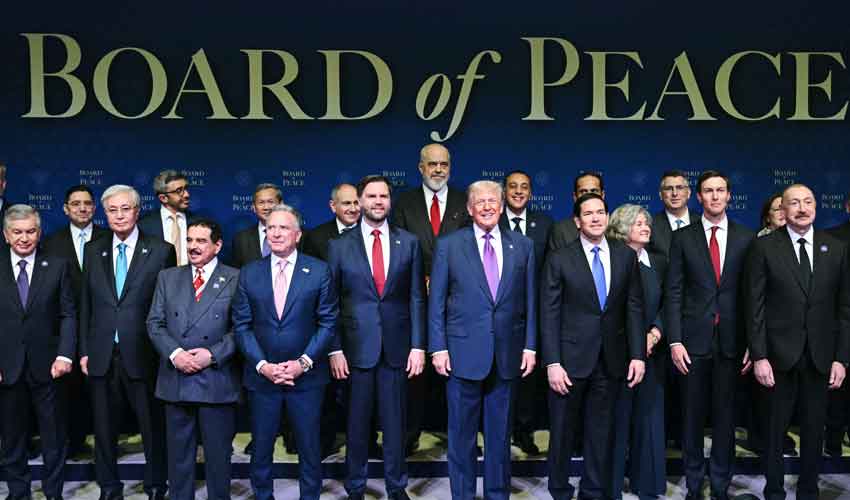
The Palestinian group Hamas has strongly condemned the convening of the so-called “Board of Peace” on Gaza in the United States, warning that no political arrangement can succeed without ending Israeli aggression.
In a statement, Hamas said any future framework for Gaza must be rooted in a complete halt to hostilities and the protection of Palestinian rights. It affirmed that any political path or arrangements regarding Gaza must begin with a full cessation of Israeli military operations.
The group also reiterated the need to lift the long-standing siege of Gaza and guarantee Palestinians their right to freedom and self-determination. It criticized the timing of the Board’s session, saying it was being held amid ongoing Israeli actions in the war-torn territory.
Call for concrete international action
In its statement, Hamas said the convening of the session “amid the ongoing crimes of the occupation and its continuous violations of the ceasefire agreement” places responsibility on the international community.
The group urged participating countries to take practical steps to compel Israel to halt its aggression, open border crossings, allow unimpeded humanitarian aid, and immediately begin reconstruction efforts.
Also Read: US to give $10bn for Gaza reconstruction, says Trump in first Board of Peace meeting
Hamas also called on mediators to ensure full implementation of the ceasefire agreement and to prevent Israel from obstructing the deal.
Warning about root causes
Hamas warned that any genuine international effort aimed at stabilizing Gaza must address what it described as the root cause of the conflict — the Israeli occupation.
It stressed that long-term stability can only be achieved by enabling Palestinians to attain their full rights.
Earlier Thursday, US President Donald Trump chaired the inaugural meeting of his “Board of Peace” in Washington, DC, at the United States Institute of Peace. The meeting focused on advancing the next phase of a fragile ceasefire in Gaza, post-war reconstruction, and key components of Trump’s broader 20-point regional peace plan.
Member nations pledged more than $7 billion toward Gaza relief and reconstruction. Trump announced an additional $10 billion contribution from the United States, and participating countries were acknowledged for their commitments.
Some countries also pledged troops for a proposed International Stabilization Force for Gaza.
Protests outside meeting
Outside the Board of Peace session, demonstrators gathered to denounce Washington’s role in the Gaza conflict.
Protesters chanted “Free Palestine” and demanded an end to what they described as decades-long occupation, as well as US complicity in what they called genocide in Gaza. They also called for accountability for Israeli war crimes.
At one point, individuals wearing masks depicting Trump, Israeli Prime Minister Benjamin Netanyahu, and US Secretary of State Marco Rubio were pushed to the ground and detained by police.
Also Read: Saudi Arabia, UAE, Qatar announce financial support for Gaza reconstruction
The Board of Peace was formally launched by Trump during a signing ceremony in Davos, Switzerland, on January 22, 2026.
Trump described it as an initiative to stabilize and rebuild Gaza following the ceasefire that took effect in October 2025 as part of his broader peace plan.
The board is chaired by Trump and includes Secretary of State Marco Rubio, special envoy Steve Witkoff, Jared Kushner, and former UK prime minister Tony Blair.
Implementation challenges and casualties
Despite the ceasefire framework, many goals outlined in Trump’s 20-point plan have yet to fully materialize on the ground.
Phase one of the plan aimed to immediately halt fighting, facilitate exchanges of Israeli captives and Palestinian prisoners, define Israeli withdrawal boundaries in parts of Gaza, allow unrestricted humanitarian aid, and reopen the Rafah crossing between Gaza and Egypt.
While the daily intensity of Israeli attacks has decreased since the ceasefire began, Palestinian officials report that more than 600 Palestinians have been killed and over 1,600 injured since the truce concluded. That equates to an average of nearly five deaths per day.
As diplomatic efforts continue, Hamas maintains that lasting peace in Gaza depends not only on reconstruction funds and security arrangements but on addressing the core political grievances at the heart of the conflict.