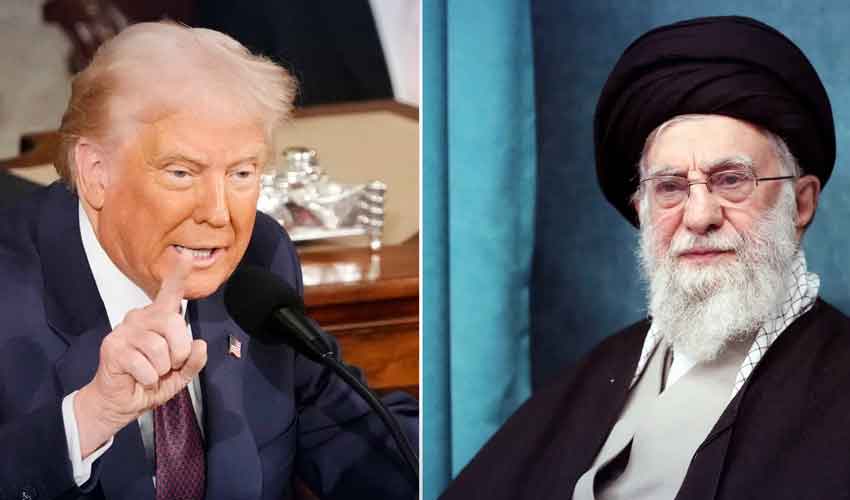
US President Donald Trump is considering launching a limited military strike on Iran in a bid to pressure Tehran into accepting a new nuclear deal, according to multiple US media reports.
The development signals a sharp escalation in tensions, with both Washington and Tehran issuing strong warnings while diplomatic talks remain ongoing.
The Wall Street Journal reported that Trump is weighing “an initial limited military strike on Iran to force it to meet his demands for a nuclear deal.”
According to people familiar with the matter, the opening strike — if approved — would target a few Iranian military or government sites. The strategy, the report said, is designed to pressure Iran without triggering a full-scale war.
If Iran refuses to end nuclear enrichment, the United States could expand the campaign to strike additional regime facilities.
One person cited by the Journal said Trump could “ratchet up his attacks, starting small before ordering larger strikes until the Iranian regime either dismantles its nuclear work or falls.”
Decision within days
Trump has indicated that a decision may be imminent.
“We’re going to make a deal or get a deal one way or the other,” he said on Thursday.
At another appearance in Washington, he added, “Maybe we’re going to make a deal. Maybe not.” He said Americans would know “over the next, maybe, 10 days,” later clarifying the window as “10 to 15 days, pretty much, maximum.”
White House spokeswoman Anna Kelly declined to detail potential actions, telling the Journal: “Only President Trump knows what he may or may not do.”
Pentagon builds up forces in Middle East
Separately, The Washington Post reported that the Trump administration “appears ready to launch an extended military assault on Iran” as the Pentagon increases its military presence in the Middle East.
The aircraft carrier USS Gerald R. Ford and accompanying warships are approaching the region. US forces deployed there are expected to be fully in place by mid-March, officials told the Post.
The military buildup has fueled speculation that Washington is preparing contingency plans in case negotiations collapse.
Iran threatens strong retaliation
Iran’s Supreme Leader Ayatollah Ali Khamenei responded with sharp warnings. He said Iranian forces could sink a US aircraft carrier and strike the American military “so hard that it cannot get up again.”
In another message, he declared: “Of course, a warship is a dangerous piece of military hardware. However, more dangerous than that warship is the weapon that can send that warship to the bottom of the sea.”
Warning of regional bases as targets
Iran has also taken its message to the international stage.
In a letter to UN Secretary-General Antonio Guterres, Tehran warned that it would consider bases, facilities and assets of the “hostile force” in the region as legitimate targets if it faces military aggression.
Iran’s permanent mission to the United Nations said Trump’s rhetoric “signals a real risk of military aggression,” though it stressed that Tehran does not want a war.
The letter stated that Iran would respond “decisively” if subjected to military aggression.
Despite the heightened rhetoric, diplomatic efforts are ongoing.
White House press secretary Karoline Leavitt said the two sides have “made a little bit of progress” but remain “very far apart on some issues.”
She added that Iranian officials are “expected to come back to us with some more detail in the next couple of weeks.”
Iran has consistently said it does not seek nuclear weapons and maintains that it has the right to enrich uranium for civilian purposes.
Tensions between Washington and Tehran have been high since the United States withdrew from the 2015 nuclear deal during Trump’s first term.
In the years since, sanctions and periodic military clashes have followed, increasing fears of a broader conflict in the Middle East.
With military assets moving into position and both sides issuing stern warnings, the coming days — as Trump suggested — may prove critical in determining whether diplomacy prevails or the region edges closer to confrontation.