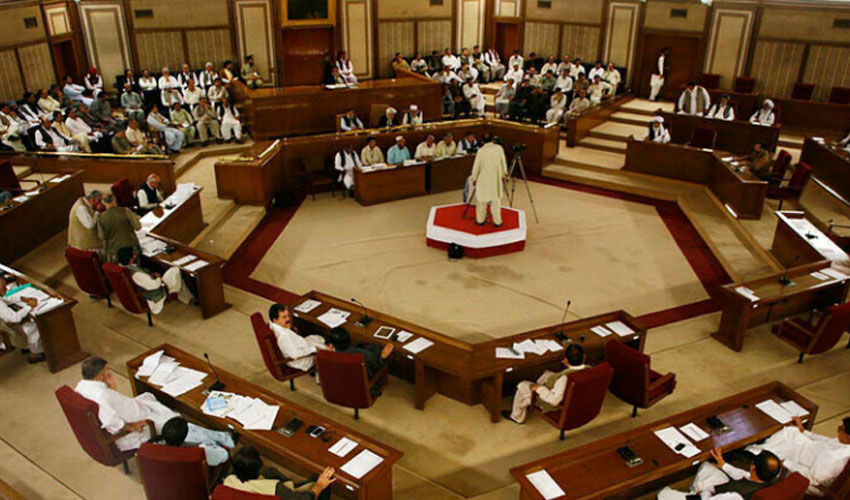
A chaotic joint session of parliament chaired by Speaker Sardar Ayaz Sadiq on Tuesday approved the National Commission for Minority Rights Bill 2025 with multiple amendments, following hours of heated exchanges, protests, and dramatic scenes on the floor.
The bill, already passed by both the National Assembly and Senate, faced strong resistance from opposition members -- particularly PTI and JUI -- despite assurances from the government that no legislation would contradict the holy Quran, Sunnah, or Islamic principles.
'Constitution does not allow any law against Quran and Sunnah'
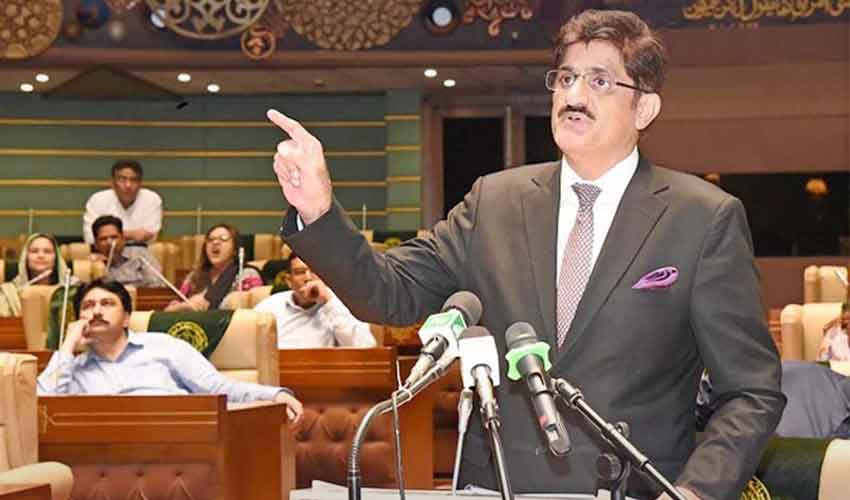
Law Minister Azam Nazir Tarar presented the bill and repeatedly stressed that the Constitution and “our conscience” do not permit any legislation contradicting the holy Quran and Sunnah. He emphasized that a commission for non-Muslims is being formed in line with constitutional and legal requirements.
"The commission will not have punitive powers. The government is abolishing the commission’s suo motu authority. Clause 35 -- related to precedence of laws -- has been abolished," he told the House. "The Supreme Court had directed the formation of such a commission in 2014."
“This is a bill for the rights of minorities. Nothing will happen to prisoner number 804,” he said, prompting laughter and remarks in the House. The minister urged lawmakers to pass the bill the same day, noting it had been under deliberation for six years.
Parties express concerns
JUI-F chief Maulana Fazlur Rehman maintained that Pakistan “cannot afford such problems,” adding that his party’s stance on minorities remains consistent. He warned that no legislation that conflicts with Islam would be acceptable.
PTI Chairman Barrister Gohar echoed the concern, stating: “No legislation against Islam can be made. This country, the nation, and parliament cannot afford it. This law will take precedence over other laws.”
Amendments proposed by the JUI and Barrister Gohar, including the removal of Clause 35, were eventually accepted.
House leadership and procedure
Senator Allama Raja Nasir Abbas objected to the absence of an opposition leader in the House and criticized the government for introducing major legislation suddenly.
“There is no opposition leader at the moment,” he said, also denying reports of meetings with the PTI founder.
An unusual moment drew laughter when Alia Kamran occupied the seat of Senator Kamran Murtaza. “You should go to your seat and ask for the floor,” Speaker Ayaz Sadiq advised.
“My seat is occupied by Alia Kamran,” Murtaza complained, prompting the speaker to joke: “Maulana Sahib, look, Kamran Murtaza is not being given a seat by Alia Kamran.”
"Sir, look at my condition in the joint session," Murtaza remarked, causing amusement across the chamber.
PPP’s Abdul Qadir Patel took the floor to declare that the House would “not accept any bargaining on the sanctity of the Prophet Muhammad (PBUH) and his family.” He supported immediate approval of the bill.
Protests erupt as PTI members surround speaker
As voting began, PTI lawmakers intensified protests, surrounded the speaker’s desk, hurled copies of the agenda and bills toward the dais, and shouted slogans. Despite disruptions, 160 votes were cast in favour of the bill and 79 against. The PPP supported the bill, while JUI opposed it despite amendments being added.
Key amendments approved
The joint session approved:
-
Abolition of the commission’s suo motu powers (Clause 12)
-
Abolition of Clause 35
-
Inclusion of amendments by Barrister Gohar and Senator Kamran Murtaza
Alia Kamran thanked the House for removing Clause 35. The amended bill was passed and stands approved.
In his remarks, the law minister urged lawmakers not to use sensitive religious issues -- such as the finality of the Prophethood (PBUH) -- for political purposes. “Pakistan cannot afford such issues,” he said.
Maulana Fazlur Rehman’s speech
Maulana Fazlur Rehman said that respect for the Constitution and the law is obligatory for all. He emphasized that any constitutional amendment must be made through consultation and consensus. He added that the Constitution should never become controversial.
He said that former prime minister Zulfikar Ali Bhutto held extensive consultations during the drafting of the Constitution, taking all provinces and political parties into confidence before approving a consensus document. Maulana Fazlur Rehman stated that although the PTI was not directly involved in the 26th Constitutional Amendment, the party remained in contact throughout the process, which ultimately resulted in a consensus-based amendment.
However, he said that the 27th Constitutional Amendment did not fulfill the requirements of democracy. The nation, he argued, was given an opportunity to question the Constitution, and since the amendment is not unanimous, it will inevitably become controversial.
He further warned that complications would arise if individuals below 18 years of age are not considered adults in certain legal matters. He also described transgender-related provisions as “un-Islamic.”
DPM Dar's remarks
Deputy Prime Minister Ishaq Dar said that the National Commission for Minority Rights Bill has been passed by both houses of parliament. He added that under the guidance of Maulana Fazlur Rehman, Senator Kamran Murtaza presented amendments to the bill, which were accepted.
Dar remarked that discussions “start with the honour of the Prophethood and end with the release of prisoner number 804.”
Legislative business conducted
-
The Convention on Biological and Toxin Weapons Implementation Bill 2024 was presented by Deputy Prime Minister Ishaq Dar and subsequently approved.
-
The Pakistan Institute of Management, Sciences and Technology Bill 2023 was passed with amendments.
-
A bill to establish the National University for Security Sciences, Islamabad was introduced.
-
The Ghurki Institute of Science and Technology Bill 2025 was passed.
-
Senator Kamran Murtaza withdrew his amendments.
The joint session of parliament was then adjourned indefinitely.