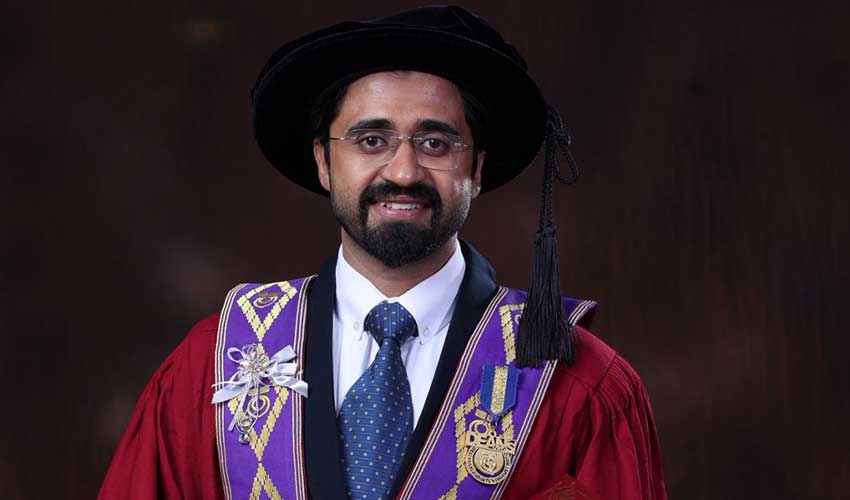
A rising Pakistani academic, Dr Usman Mehmood, has made headlines in Malaysia after earning some of the highest distinctions awarded by Universiti Teknologi Malaysia (UTM), one of Asia’s leading research institutions.
His achievements have sparked pride among the Pakistani academic community and placed the country’s geospatial talent firmly on the international map.
Dr Usman, who hails from Islamabad, was honoured with the Pro-Chancellor Award, a rare and distinguished recognition given only to exceptional PhD graduates at UTM’s 69th Convocation. At a ceremony attended by scholars from more than 90 countries, he stood out as the only international student invited to the stage, a moment that drew both applause and admiration across the hall. For the field of Geoinformatics, his recognition placed it shoulder-to-shoulder with more traditional scientific disciplines and reaffirmed its growing global stature.

His doctoral journey impressed examiners not only for its depth but for its steady stream of high-impact contributions. His thesis was accepted with distinction, and his research efforts produced six international journal publications, several influential conference papers, and strong innovations in 3D spatial analytics and smart building maintenance. His work, praised for its originality and precision, contributes to emerging technologies that support urban planning and the management of complex high-rise environments—areas increasingly relevant for both Malaysia and Pakistan.
Alongside the Pro-Chancellor Award, Dr Usman also received the Dean’s Award and the Best Student Award from UTM, further cementing his reputation as one of the most outstanding young researchers at the university. Adding to this streak, he was also recently recognized through the ESRI Award, an honour that celebrates promising geospatial scholars whose work shows clear potential for real-world impact.
Behind these achievements lies a strong academic foundation built in Pakistan. Dr Usman completed his Master’s in Earth Sciences from Quaid-i-Azam University (QAU), where his interest in spatial processes first took shape. He later pursued his MS in Remote Sensing and GIS from COMSATS University Islamabad, sharpening his analytical and technical abilities before stepping into advanced research in Malaysia. These early academic experiences, combined with long hours of study, fieldwork, and experimentation, shaped the scholar who now represents Pakistan on global platforms.
Dr Usman credits much of his success to the guidance of his supervisor, Assoc. Prof. Dr Muhamad Uznir Ujang, a leading figure in geospatial research at UTM. Their collaboration produced strong research outputs and a doctoral project that examiners described as timely, rigorous, and impactful. Those close to his journey note that his humility, consistency, and appetite for learning made him stand out long before he appeared on any convocation stage.
For Pakistan, Dr Usman’s achievements demonstrate not only personal excellence but also the country’s growing capability in frontier technologies like GIS, geospatial intelligence, and 3D urban analytics. At a time when digital mapping and spatial innovation are transforming global cities, his success story serves as a reminder that Pakistan’s academic talent, when nurtured and given global exposure, can compete at the highest levels.
With several new research projects already under way, Dr Usman is determined to continue contributing to the geospatial sciences, carrying both Pakistan’s flag and its aspirations into the international research arena.







.jpeg)