The motion for the 27th Constitutional Amendment Bill was formally presented in the National Assembly on Tuesday by Law Minister Nazir Tarar, marking a significant step in the government’s legislative agenda.
The proposed amendment is part of the 10-point agenda released for today’s parliamentary session.
The National Assembly session began shortly before noon, with the approval of the 27th Constitutional Amendment Bill being the central item on the agenda.
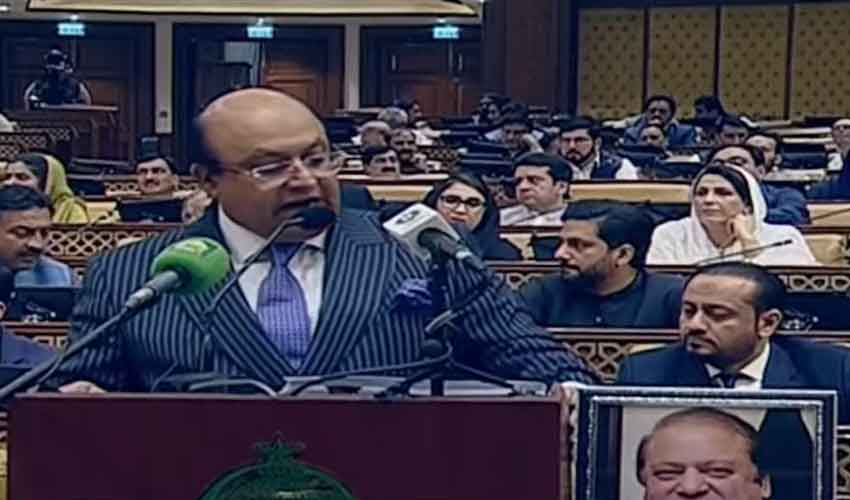
Speaking on the floor of the House, Law Minister Azam Nazir Tarar said that after extensive discussions, it was decided to address the long-pending issue left unresolved in the 18th Amendment — the establishment of a Federal Constitutional Court. He confirmed that consultations were held with leaders from the Pakistan People’s Party (PPP), Muttahida Qaumi Movement (MQM), Istehkam-e-Pakistan Party (IPP), Pakistan Awami Party, Awami National Party (ANP), and Pakistan Muslim League-Q (PML-Q), and a consensus was reached on forming the new court.
Also Read: Senate approves 27th Amendment bill with two-thirds majority
He stated that the Senate has passed a bill with a two-thirds majority to establish the Federal Constitutional Court, a proposal originally included in the Charter of Democracy. The new court will ensure equal representation from all federal units, while the Islamabad High Court will also be represented.
Addressing misconceptions, Tarar clarified that Article 184(3) of the Constitution has not been abolished, but its jurisdiction has now been entrusted to the Federal Constitutional Court. The change was made following deliberations in the joint parliamentary committee of both houses, after the Senate’s approval of the bill.
The minister expressed regret that opposition members chose not to participate in the process, despite it being their constitutional responsibility to contribute to such an important reform. He noted that Senators Kamran Murtaza and Alia Kamran from JUI initially participated but later excused themselves due to their party’s decision.
Reflecting on Article 184(3), Tarar explained that the suo motu powers -- a rare authority not found in most judicial systems -- had often been misused in Pakistan. “This power, which entered our judicial system as a monster, was at times used against prime ministers, government officials, and even actors,” he remarked. “At one point, it even sought to fix the country’s economic system.”
He cited instances such as the $9 billion fines in the Pakistan Steel Mills and Reko Diq cases, and recalled how former chief justices had taken suo motu notice of issues like hospital inspections and dam construction. “After Yousaf Raza Gilani, another prime minister was nearly sent home under suo motu powers,” he added.
The law minister confirmed that a bill has been presented in the Senate to abolish the suo motu powers. “Suo motu will no longer be used to target individuals,” he asserted.
Tarar also discussed proposals regarding the transfer of judges, previously governed under Article 200, which allowed the president to recommend or order the transfer of a high court judge. He said that in the past, such transfers had often been challenged on constitutional grounds.
After thorough deliberations, it was decided to amend Article 200 and establish a judicial commission to handle transfers and appointments of judges. The commission will be headed by the chief justice and will include five judges from the Supreme Court and the Constitutional Court.
Also Read: PTI Senator Abro resigns, JUI expels Ahmed Khan for breaking party line
In addition, the Judicial Commission will include two members each from the government and opposition benches, as well as representatives from the speaker’s office, bar council, attorney general, and the law minister. The commission responsible for appointing judges will now also have the power to transfer them, ensuring greater transparency and institutional balance within the judiciary.
Under Article 209, the Supreme Judicial Commission will now comprise seven judges — five from the Supreme Court and the Federal Constitutional Court, along with the two senior-most chief justices. Matters relating to judicial transfers will be referred to this body, which will determine whether such transfers are appropriate.
With the establishment of two apex courts, it has been emphasized that there must be consistency and harmony in the orders passed under Article 199 in high court writ petitions. The Supreme Court will hear cases according to the categories defined in the Constitution, including criminal, civil, corporate, cooperative, commercial, taxation, and inheritance matters. Across the country, between 60,000 and 62,000 cases of these types are heard collectively by the Supreme Court and the high courts.
The chief justice of Pakistan currently heads several key judicial bodies, including the Judicial Commission of Pakistan and the Supreme Judicial Council. Under the 27th Constitutional Amendment, the senior-most judge between the two apex courts will serve as the head of the Judicial Commission.
Regarding the composition of the judicial panel, it has been proposed that it include five judges — the chief justice of the Supreme Court, the chief justice of the Federal Constitutional Court, and the senior-most judges from both courts. The fifth member will be jointly nominated by the two chief justices with mutual consent. If no consensus is reached, the matter will be referred to the commission for resolution.
With the passage of the 27th Constitutional Amendment, the current chief justice of Pakistan will continue to head all constitutional commissions and judicial institutions.
Also Read: Opposition alliance rejects 27th Amendment as ‘unconstitutional’
Addressing the delay in the Khyber Pakhtunkhwa Senate elections, the law minister explained that the issue was primarily political. Elected members were not allowed to take the oath despite a court order, leading to a delay that eventually brought the matter before the Supreme Court, where it was postponed for a year.
The minister clarified that the Senate is never dissolved; new senators are elected from all provinces every three years. However, a 14-month gap occurred before the next round of elections — a matter that has now been resolved through consultation.
If there is a delay in taking the oath within the six-year tenure of an elected senator, or if elections are held late, the delayed period will be deducted from their total term. This adjustment was introduced to remove ambiguity and ensure the Senate system continues to function smoothly without disruption.
Barrister Gohar’s remarks
Barrister Gohar said that constitutional amendments are a deeply sensitive matter, as they directly affect the democratic fabric of any nation. In countries where the constitution is amended, people celebrate such moments, believing that these changes are meant to solve their problems. However, he lamented that today is a day of mourning for democracy in Pakistan.
He said, “Those who claim to be champions of democracy and raise slogans of ‘respect the vote’ are, in fact, taking steps to bury democracy.”
Barrister Gohar recalled that when the PDM government came to power in April, it moved quickly to amend the NAB Ordinance in May. He said that cases involving amounts below Rs500 million were then excluded from the definition of corruption, allowing several leaders to close or set aside their own cases.
He added that the government was now introducing further amendments to exempt itself from future accountability. “In democratic countries, being answerable before the law is the essence of democracy,” he said, adding that true democracy means the supremacy of law and accountability.
Drawing parallels and questioning justice
Barrister Gohar cited the example of Queen Elizabeth and Prince Andrew, saying, “When a girl filed a civil suit against Prince Andrew in New York, Queen Elizabeth told her son he would not defend himself as a prince. That is accountability.”
He questioned, “In the Park Lane reference involving Rs4 billion — whose corruption is it? Can I not claim innocence when I appear in court for corruption cases?” He vowed that his party would continue efforts to bring the corrupt to justice, asking, “Will you sit comfortably in your homes after changing the law and the constitution?”
Referring to his party leader, he added, “The iron man is waiting. The day he returns, we will rise again. Whatever he says will be the true constitution.”
Critique of government priorities
Barrister Gohar criticized the elite class, saying that while the public suffers from hunger, lack of hospital beds, and absence of justice in police stations and courts, the rulers are changing laws to protect themselves. “Do we want to create an elite class that stands above the law?” he asked.
He said, “Salute to your thinking, salute to your fear. But remember, excuses must end now.”
Concerns over judicial changes and Article 176
Addressing the law minister, Gohar said that when the Federal Constitutional Court was proposed, the number of Supreme Court judges was increased from 16 to 33, and 53 judges were appointed to the high courts and Supreme Court. He noted that 56,000 cases are currently pending in the Supreme Court, yet the government is forming a new court to deal with only 149 constitutional cases under Article 184.
He warned that the move was not about justice but about weakening the judiciary, saying, “The judiciary is the fortress that protects the people from the government’s assault on their fundamental rights — and now, they want to conquer this fortress.”
'Chief justice of Pakistan' title abolished
Barrister Gohar also criticized the amendment to Article 176, saying it effectively abolished the title of “chief justice of Pakistan.”
“After this amendment, Pakistan will no longer have a chief justice — only a chief justice of the Supreme Court. When constitutional or judicial conventions are held around the world, Pakistan will not be represented by that title anymore,” he said.
Calling it a grave injustice, he urged the government not to erase the identity of the country’s top judicial office. “You have abolished the title of chief justice of Pakistan forever,” he said.
Warning over divisive amendments
Barrister Gohar concluded by saying that constitutional changes made through consensus strengthen democracy, but those passed without consultation only divide the nation. “Congratulations to the prime minister,” he remarked sarcastically, “the amendment passed by just two votes yesterday. Amendments made by luck or numbers will not serve the people — they will only weaken democracy.”
Ruling coalition poised for smooth approval
The ruling coalition is expected to secure the amendment’s passage with ease, as it commands a clear two-thirds majority in the lower house. A total of 224 votes are required for the bill’s approval, while the coalition currently holds a comfortable majority of 237 members.
According to party breakdowns, 126 members of the PML-N and 74 members of the PPP have pledged their support for the amendment. The MQM’s 22 members, five from the PML-Q, four from the Istehkam-e-Pakistan Party (IPP), one each from the PML-Z and the BAP, and four independent members are also expected to vote in favour of the constitutional amendment.
Today’s 10-point agenda not only includes the 27th Amendment but also covers additional legislative and policy discussions.
On Monday, the Senate had approved the 27th Constitutional Amendment Bill with two-thirds majority. The bill secured 64 votes in favour and none against. The result was announced by the Senate chairman following a division of votes. The results came after the House approved the bill clause-wise following its introduction by Law Minister Senator Azam Nazir Tarar.
Also Read: 27th Amendment: Details of all changes approved in bill
The session witnessed heated protests from opposition members, who tore up copies of the agenda in protest.
The opposition staged a walkout during the session. JUI-F’s Ahmed Khan and PTI’s Saifullah Abro remained present in the house. Both lawmakers voted in favour of the amendment.
“Our party constitution and the Senate’s rules were violated by Kamran Murtaza,” a party member said. Kamran Murtaza added, “Action will be taken once Maulana Fazlur Rehman returns from Bangladesh.”
He further stated, “Article 62 will be applied to those who vote against the party policy. Any member who violates the party constitution will lose their Senate membership.”







.gif)

.jpg)