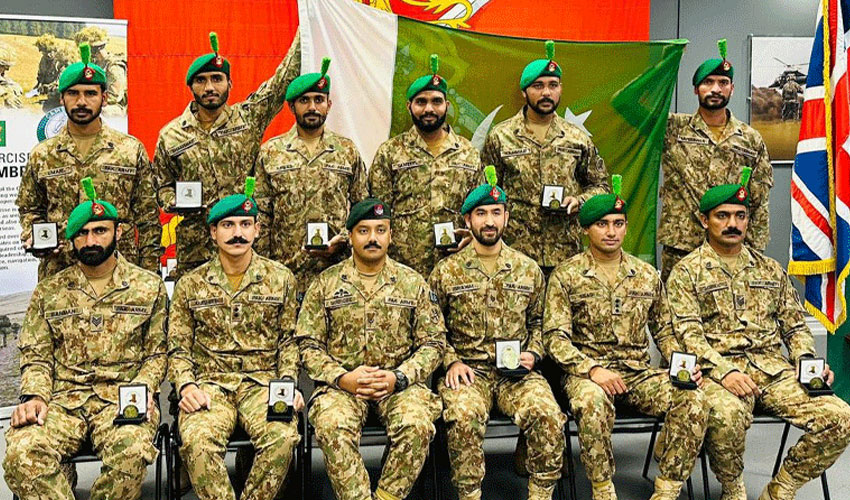
The Pakistan Army has won a gold medal at the prestigious Exercise Cambrian Patrol 2025 held in Wales, United Kingdom.
The team, led by Captain Muhammad Saad, outperformed 137 teams from 36 countries in the world-renowned military competition.
According to the Inter-Services Public Relations (ISPR), the Cambrian Patrol 2025 exercise took place from October 3 to 13 in Wales. This year marked the 66th edition of the event, which is widely regarded as one of the most challenging and professionally demanding military exercises globally.
The participating teams were required to cover a 60-kilometer distance within 48 hours through rugged and inhospitable terrain while completing a series of tactical and technical missions under simulated combat conditions.
Pakistan team displays exceptional skill
Out of 137 international teams, the Pakistan Army contingent, led by Captain Muhammad Saad, delivered an outstanding performance and secured the Gold Medal, showcasing exceptional endurance, leadership, and coordination.
The ISPR lauded the achievement, calling it a reflection of the Pakistan Army’s professional excellence and dedication. “This success is a matter of pride for the entire nation. The Pakistan Army stands distinguished for its superior training standards, discipline, and determination,” the statement read.
The Cambrian Patrol is an annual military exercise organized by the British Army in Wales. It aims to test soldiers’ stamina, tactical planning, teamwork, and ability to operate in difficult terrains under pressure.
The competition attracts top military units from across the globe, often described as the “Olympics of military patrolling” due to its intensity and prestige.
The Pakistan Army has consistently performed with distinction in previous editions of the Cambrian Patrol, often securing top honors. This year’s gold medal once again reinforces its reputation for professionalism and world-class training.
“The Pakistan Army has always kept the national flag high and will continue to bring pride to the nation in the future as well,” the ISPR statement added.
.png)


.jpg)