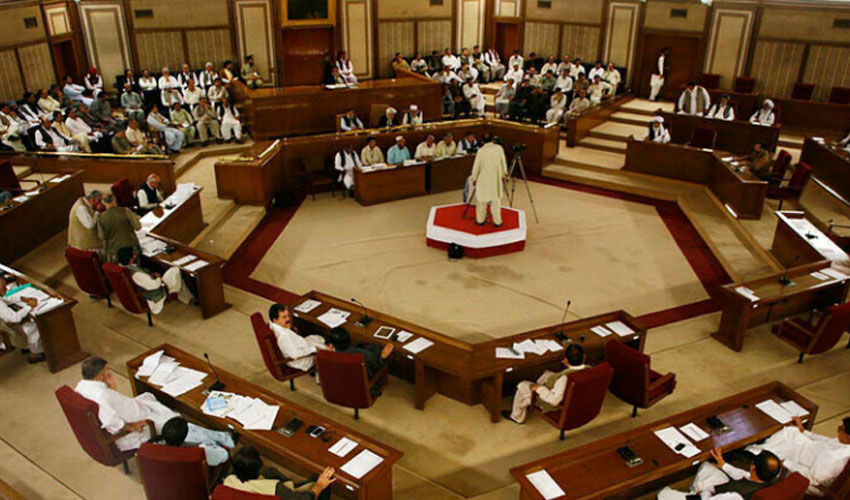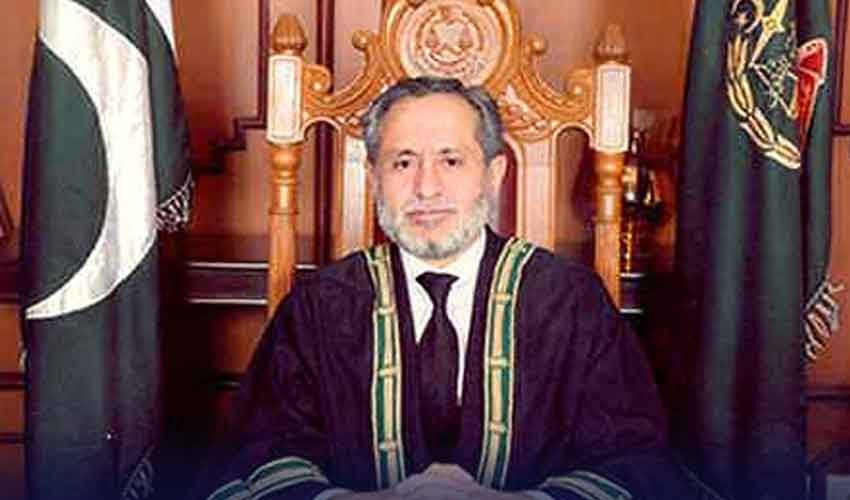
Supreme Court's Justice Jamal Khan Mandokhail remarked on Thursday during proceedings on reserved seats that judiciary cannot be expected to resolve matters that politicians themselves are unwilling to address
The observation came as an eleven-member constitutional bench, headed by Justice Aminuddin Khan, heard review petitions against the verdict on reserved seats. During the hearing, counsel for the Pakistan Tehreek-e-Insaf (PTI), Salman Akram Raja, concluded his arguments, while senior advocate Hamid Khan’s request to postpone the case until August was dismissed.
In his submissions, Raja argued that constitutional violations are rectified through constitutional remedies by the Supreme Court. Citing Section 66 of the Elections Act, he maintained that a political party issues tickets to candidates and that no third-party attestation is required for this process.
He contended that the Election Commission of Pakistan's (ECP) decision on 24 December 2023 — declaring PTI no longer a political party — was unconstitutional and added complexity to the matter. According to him, all candidates had declared affiliation with the PTI and submitted the necessary documentation to the court.
Justice Aminuddin Khan observed that only 39 candidates had declared their association with the PTI, while the rest had not. He noted that when PTI itself admitted that its intra-party elections had not been properly conducted, consequences were inevitable.
Justice Muhammad Ali Mazhar pointed out that PTI had been granted multiple extensions over the years to conduct party elections. Justice Mandokhail reiterated his earlier concern: if politicians do not take responsibility for internal matters, what role is left for the courts?
He questioned whether the judiciary could compel individuals such as Nawaz Sharif, Bilawal Bhutto-Zardari or Maulana Fazlur Rehman to contest elections only through political parties if they chose to run as independents.
Raja warned that if PTI were not recognised as a political party, 80 reserved seats would be distributed among the Pakistan Muslim League (PML-N), Pakistan Peoples Party (PPP) and Jamiat Ulema-e-Islam-Fazl (JUI-F), which he argued would undermine the democratic rights of the Pakistani electorate.
He also stated that eleven Supreme Court judges had rejected the ECP’s interpretation of Rule 94, which had formed the basis for revoking PTI’s election symbol and reserved seats.
Initiating his arguments, Hamid Khan stated that the court had convened on a public holiday to strip PTI of its electoral symbol.
The court adjourned the hearing for one day.



.jpg)