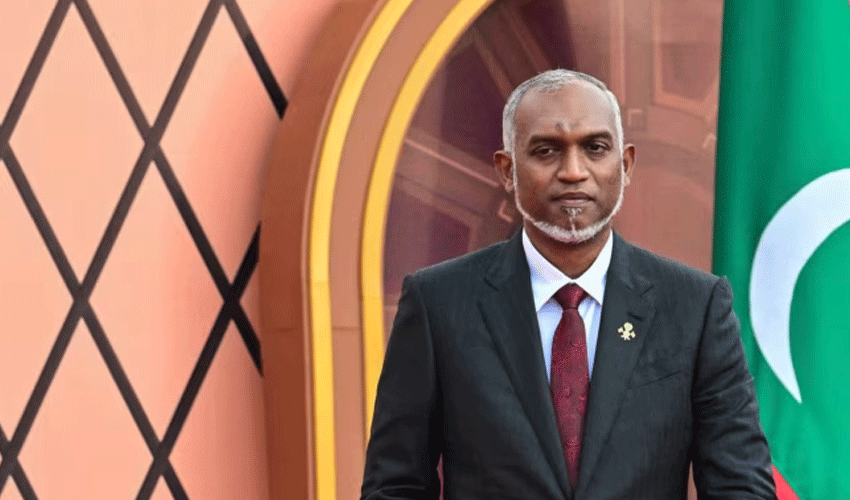
Maldives President Mohamed Muizzu broke the previous record for the longest presidential press conference by addressing the media for nearly fifteen hours, his office confirmed on Sunday.
President Muizzu, aged 46, commenced the unprecedented event at 10:00 am (0500 GMT) on Saturday. According to a statement from his office, the conference lasted for fourteen hours and fifty-four minutes, punctuated by brief pauses for prayers.
"The conference extended past midnight – a new world record by a president – with President Muizzu continuously responding to questions from journalists," the official statement declared.
Ukraine’s National Records Agency had previously recognised a fourteen-hour press conference conducted by Ukrainian President Volodymyr Zelensky in October 2019, which eclipsed a prior record of over seven hours held by Belarusian leader Alexander Lukashenko.
The government of the Indian Ocean archipelago stated that President Muizzu’s extended session had also been aligned with World Press Freedom Day, observed on Saturday.
"He acknowledged the crucial role of the press in society and emphasised the importance of factual, balanced, and impartial reporting," the statement added.
The statement further revealed that President Muizzu, who assumed power in 2023, responded not only to journalists but also to questions submitted by members of the public via the media.
His office also noted that the president marked his nation’s rise by two places to 104th out of 180 countries in the 2025 World Press Freedom Index, published by Reporters Without Borders (RSF), during the marathon press event.
The session encompassed a wide range of topics, as detailed by the official communication.
Approximately two dozen reporters attended the press conference and were provided with food.
A predecessor of President Muizzu, former president Mohamed Nasheed, had set a separate record in 2009 by conducting the first-ever underwater cabinet meeting to highlight the environmental threat posed by rising sea levels.
President Nasheed descended into the Indian Ocean with his cabinet ministers, all in scuba gear, for a nationally televised session.
The Maldives remained on the frontline of the global warming battle, facing potential devastation from rising sea levels across its 1,192 low-lying coral islands scattered around the equator.