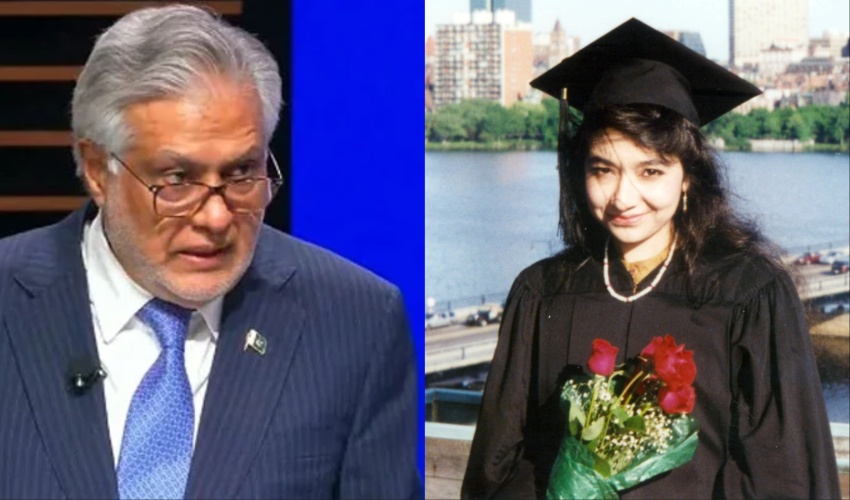
Deputy Prime Minister Ishaq Dar has said that Pakistan made "desperate and sincere" efforts for the release of Dr Aafia Siddiqui calling her the “daughter of Pakistan” and reiterating that her case remains a matter of national concern.
Addressing the Pakistani community in New York, Mr Dar said the government had pursued every possible diplomatic avenue to secure the release of Dr Siddiqui.
“We made repeated efforts for her release and even submitted a request for her pardon before President Joe Biden completed his term,” he said.
Calling the neuroscientist’s imprisonment a humanitarian issue, Mr Dar emphasised that Islamabad continues to raise the matter with Washington.
RELATED: Ishaq Dar clarifies remarks on Dr Aafia Siddiqui case
“Let no one be mistaken — Dr Aafia Siddiqui is the daughter of Pakistan,” he said, adding that the government remains committed to her case.
‘We saved country from bankruptcy,’ claims Dar
Mr Dar claimed that the coalition government, under Prime Minister Shehbaz Sharif’s leadership, had steered the country away from economic collapse.
“If the PTI government had remained for another six months, the country would have gone bankrupt,” he said.
He termed the no-confidence motion against the PTI a difficult but necessary step, adding that it was done for the sake of the country’s stability.
Foreign reserves up, inflation down
Highlighting what he called an economic turnaround, Mr Dar said:
“We have achieved economic stability. Foreign exchange reserves are increasing, inflation has come down, and GDP growth has rebounded.”
He added that all major international financial institutions had recognised Pakistan’s economic improvements and said the government’s long-term target was to include Pakistan in the G20.
Overseas Pakistanis are nation’s capital
Calling overseas Pakistanis the “country’s capital,” the deputy prime minister urged the diaspora to play an active role in Pakistan’s development. He said the government was working to facilitate investment opportunities and reduce bureaucratic hurdles for expatriates.
Mr Dar said Pakistan had returned to the global diplomatic stage after years of near-isolation. “Previously, no one invited us. Today, we are active across the world,” he said.
He described his recent meeting with US Secretary of State Antony Blinken as “very useful,” adding that bilateral issues were discussed in detail.
Mr Dar stressed that while Pakistan seeks stronger ties with the United States, these should not be viewed through the lens of its relationship with China. “We want strong relations with the US, but not at the cost of our strategic friendship with China,” he clarified.
Clear message delivered to Afghanistan on terrorism
On regional security, Mr Dar said Pakistan was determined to eliminate terrorism and had conveyed a strong message to Afghan officials. “We told Afghanistan not to allow its soil to be used against Pakistan. We are their well-wishers, but our security is non-negotiable,” he said.
Reaffirming Pakistan’s commitment to peaceful coexistence, Mr Dar said, “We want good relations with India.” However, he warned that Pakistan would respond firmly when provoked.
“We gave a befitting reply to Indian aggression — from shooting down Rafale jets to closing our airspace,” he added.
He also noted that Pakistan had offered an international probe into the Pahalgam incident and had worked to expose Indian “propaganda” at the global level.
Mr Dar said Pakistan’s recent election as president of the United Nations Security Council demonstrated renewed international confidence in the country. “Under Prime Minister Shehbaz Sharif’s leadership, Pakistan is regaining its place on the global stage,” he said.



.jpg)