Newly appointed NATO Secretary General Mark Rutte has strongly defended the need for higher defence spending and reiterated his support for US President Donald Trump’s recent military strike on Iran, calling it a “decisive action” in a moment of rising global tensions.
Speaking ahead of a NATO summit in The Hague on Wednesday, Rutte underscored the importance of strengthening collective defence budgets, citing continued threats from Russia and the growing military buildup in China.
"Given our long-term threat of Russia, but also the massive build-up of the military in China, and the fact that North Korea, China, and Iran are supporting the war effort in Ukraine, it's really important we spend more. So that will be number one on the agenda today," Rutte told reporters before meeting with world leaders at the NATO summit in the Hague.
He also addressed questions about his earlier messages praising Trump’s airstrikes on Iranian nuclear facilities. Trump had shared screenshots of congratulatory texts from Rutte on social media, calling the US action “truly extraordinary". Rutte said he stood by his message about Trump for his “decisive action in Iran".
Also Read: Iran’s parliament approves bill to suspend cooperation with IAEA
Despite media reports, particularly from CNN, questioning the effectiveness of the strikes — which reportedly set back Iran’s nuclear program by only a few months — Rutte stood by his assessment.
“The 14 huge bombs dropped on the nuclear facility in Iran, I think this was crucial to really do everything possible to take out the nuclear capability of the Iranians, which NATO has always said Iran should not get its hands on,” Rutte said.
CNN’s Tuesday report cited early US intelligence assessments indicating that while the strikes damaged some sites, Iran’s core nuclear infrastructure remained largely intact.
With defence spending set to rise, Trump reassures NATO allies
NATO leaders were set to sign up on Wednesday to a big increase in defense spending at a short summit tailor-made for US President Donald Trump, who struck a reassuring tone on his commitment to protecting fellow members of the alliance.
The summit is expected to endorse a higher defence spending goal of 5% of GDP - a response to a demand by Trump and to Europeans' fears that Russia poses a growing threat to their security following the 2022 invasion of Ukraine.
NATO Secretary General Mark Rutte acknowledged that it was not easy for European countries and Canada to find the extra money but said it was vital to do so.
Also Read: US strikes failed to destroy Iran’s nuclear sites: Early assessment
"There is absolute conviction with my colleagues at the table that, given this threat from the Russians, given the international security situation, there is no alternative," he told reporters.
Debate over NATO mutual defence pledge
Speaking to media before the summit opened, Trump played down concerns over his commitment to mutual defence among allies as set out by Article 5 of NATO's charter, saying: "We're with them all the way."
The debate has been fuelled by Trump's own comments en route to the summit on Tuesday. Speaking to reporters aboard Air Force One, he had said there were "numerous definitions" of the clause.
Finnish President Alexander Stubb, whose country borders Russia and joined NATO two years ago, said the alliance was evolving.
"I think we're witnessing the birth of a new NATO, which means a more balanced NATO and a NATO which has more European responsibility," he told reporters.
Spending to jump by hundreds of billions
The new spending target - to be achieved over the next 10 years - is a jump worth hundreds of billions of dollars a year from the current goal of 2% of GDP, although it will be measured differently.
Countries would spend 3.5% of GDP on core defence - such as troops and weapons - and 1.5% on broader defence-related measures such as cyber security, protecting pipelines and adapting roads and bridges to handle heavy military vehicles.
All NATO members have backed a statement enshrining the target, although Spain declared it does not need to meet the goal and can meet its commitments by spending much less.
Also Read: Iran won't abandon its nuclear technology at all: Araghchi
Rutte disputes that but accepted a diplomatic fudge with Spanish Prime Minister Pedro Sanchez as part of his efforts to give Trump a diplomatic victory and make the summit go smoothly.
Spain said on Wednesday that it did not expect its stance to have any repercussions.
Trump to meet Zelenskiy
Rutte has kept the summit and its final statement short and focused on the spending pledge to try to avert any friction with Trump.
Ukrainian President Volodymyr Zelenskiy had to settle for attending the pre-summit dinner on Tuesday evening rather than the main meeting on Wednesday, although he was set to meet Trump separately.
Hungarian Prime Minister Viktor Orban diluted the display of unity when he told reporters that NATO had no business in Ukraine and that Russia was not strong enough to represent a real threat to NATO.
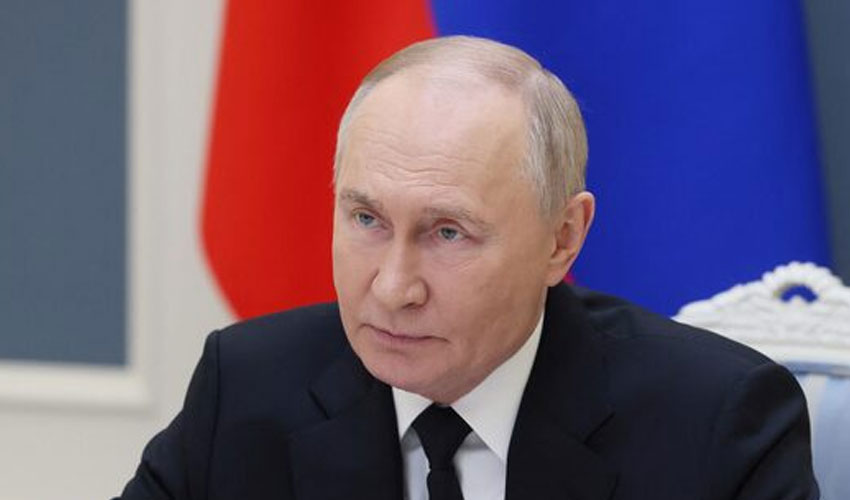
The Kremlin has accused NATO of being on a path of rampant militarisation and portraying Russia as a "fiend of hell" in order to justify its big increase in defence spending.

.jpg)