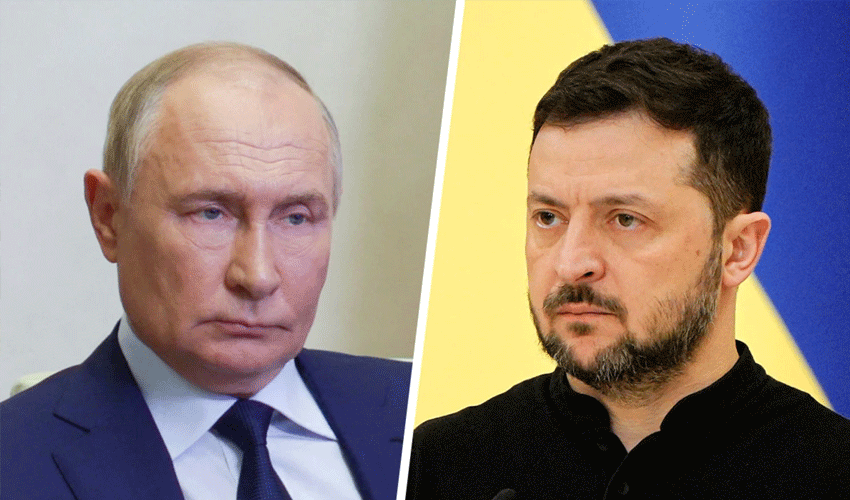
A three-day ceasefire unilaterally announced by Russian President Vladimir Putin has officially come into effect, coinciding with Russia’s preparations for its annual World War II Victory Day commemorations.
However, Kyiv has alleged that Moscow breached the truce within hours of its commencement.
The ceasefire, which began at midnight on Wednesday (local time), was declared late last month by the Kremlin, citing “humanitarian considerations.” It is set to last until midnight on May 11, overlapping with Russia’s Victory Day celebrations on May 9 — a key date in the country’s political and military calendar.
Russian state media outlet Tass confirmed the ceasefire’s start time, but within three hours, Ukraine’s air force claimed that Russia had launched guided aerial bombs over the Sumy region in northern Ukraine. The claims, reported by Reuters, have not been independently verified.
Kyiv has dismissed the ceasefire as a symbolic gesture lacking sincerity. Ukrainian President Volodymyr Zelensky previously described the move as a “theatrical performance” and reiterated his government’s support for a 30-day ceasefire proposed by the United States — a plan Russia has refused to endorse.
“This is not about peace. This is about optics,” said a Ukrainian official, speaking on condition of anonymity. “While the Kremlin stages parades, our cities remain under threat.”
The Victory Day parade, scheduled for Friday in Moscow, is expected to feature military displays and a gathering of foreign dignitaries aligned with Russia. Among those on the guest list are Chinese President Xi Jinping, Brazilian President Luiz Inacio Lula da Silva, Vietnamese President To Lam, and Belarusian President Alexander Lukashenko. Russian presidential aide Yuri Ushakov confirmed that 29 world leaders were invited to attend.
Analysts view the parade and the associated ceasefire as attempts by Moscow to project normalcy and international support amid its prolonged invasion of Ukraine, now in its third year. In previous years, the Kremlin has used the event to draw parallels between its campaign in Ukraine and the Soviet Union’s fight against Nazi Germany — a narrative dismissed by Western governments and Ukrainian officials as disinformation.
Adding to the tension, Ukrainian drones targeted Moscow for the second consecutive night leading up to the ceasefire. The attacks disrupted air traffic at 13 Russian airports, including four in Moscow. Authorities said one drone was shot down en route to the capital on Wednesday afternoon.
Moscow Mayor Sergey Sobyanin confirmed the incident and noted that defensive measures were actively in place. The temporary closure of airports comes at an inconvenient time for Russian authorities, as foreign delegations arrive for the Victory Day parade.
Despite the ceasefire announcement, President Zelensky made it clear that Ukraine would not engage in diplomatic gestures that might offer political cover for the Russian leadership. “We are not going to create a pleasant atmosphere for Putin’s return to the international stage on May 9,” he said.
The current truce marks the second short-term ceasefire declared by Putin in under a month. A previous pause during Orthodox Easter lasted roughly 30 hours, but Ukraine reported violations shortly after it began — though it acknowledged a brief reduction in fighting along some parts of the front.
As both sides continue to clash diplomatically and militarily, the ceasefire’s practical impact remains uncertain. International observers have yet to confirm whether the truce is being upheld or breached.