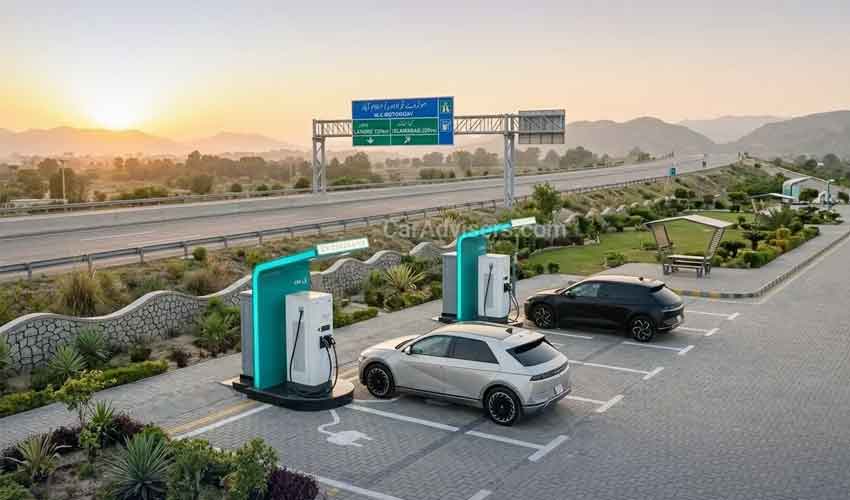
Pakistan’s push toward electric mobility faces a major infrastructure challenge, with a government document showing that most EV charging stations operating across the country remain unregistered.
According to a document from the National Energy Efficiency and Conservation Authority (NECA), only 47 charging facilities are registered, while 175 remain unregistered.
The figures show that approximately 79% of the country’s EV charging stations are unregistered, while only 21% have been registered with NECA.
Out of more than 200 charging facilities identified nationwide, the number of officially registered EV chargers stands at just 47, compared with 175 unregistered chargers.
The figures highlight the need for better regulation and a more organized charging network as Pakistan seeks to promote electric vehicles.
Islamabad leads in charging facilities
The Islamabad region has the highest number of electric vehicle charging facilities in the country, with 78 chargers, according to the NECA document.
Multan ranks second, while Faisalabad stands third in terms of the number of EV charging facilities.
However, the national distribution remains highly uneven, with some parts of the country having little or no charging infrastructure.
No chargers in Balochistan, tribal districts
The document reveals that there is currently not a single EV charger in Balochistan or the tribal districts.
The absence of charging infrastructure in these areas presents a significant challenge for the wider adoption of electric vehicles and highlights the geographic imbalance in Pakistan’s existing EV network.
Govt plans 46 new charging stations
To strengthen the country’s electric vehicle infrastructure, a plan has been prepared to establish 46 new EV charging stations and battery-swapping facilities across Pakistan.
The expansion will involve government institutions, public-sector organizations and private companies.
The Federal Development Authority (CDA) is set to establish four electric vehicle charging stations, according to the document.
The Punjab Transport Company will establish 16 charging stations, while Hubco Green plans to set up eight.
The Sindh Mass Transit Authority will establish another four charging stations.
In addition, a private company will establish 14 battery-swapping stations, bringing the planned expansion to 46 new charging and battery-swapping facilities.
The planned expansion is part of the government’s broader mission to promote electric vehicles and develop the infrastructure required to support their use.
Increasing the number of charging points and battery-swapping facilities could make EVs more practical for consumers while helping address the current shortage of infrastructure outside major urban centres.
However, the large number of unregistered facilities also points to the need for stronger oversight and registration as Pakistan builds its national electric mobility network.