Months of fighting with Iran have placed growing pressure on US weapons stockpiles, with American officials warning that critical missile and air-defense inventories have fallen to levels that could affect Washington’s ability to respond to another major conflict.
The depletion has prompted the Pentagon to move weapons and military assets from Europe and Asia to the Middle East, delay some deliveries to allies and order defense companies to dramatically accelerate production.
According to The New York Times, the war launched by President Donald Trump against Iran has consumed thousands of expensive missiles and other precision-guided weapons, drawing supplies from US forces stationed in Europe and Asia.
Senior officials told the newspaper that the shrinking supply of air-defense missiles and other critical weapons has privately alarmed senior Trump administration officials. The shortages have also forced Washington to delay deliveries of some systems to European and Asian customers.
The Pentagon has rushed ships, aircraft and air-defense units from Europe and Asia to the Middle East, creating what officials describe as cascading consequences for equipment maintenance, troop morale and the overall level of American firepower in those regions.
The situation has raised concerns across the US military and intelligence communities about the longer-term consequences of maintaining American deterrence in Europe and the Indo-Pacific.
More than 1,500 Patriot interceptors used
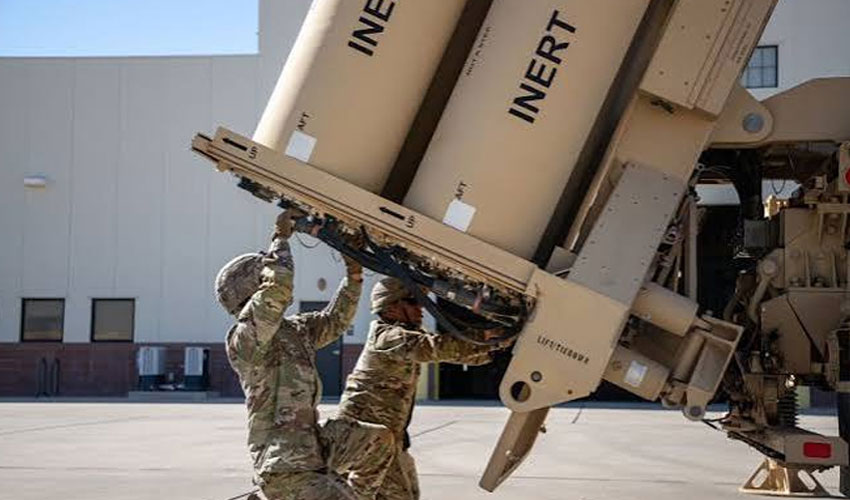
One of the most serious concerns involves the Patriot air-defense system.
The New York Times reported that the United States has used more than 1,500 Patriot interceptor missiles during the Iran war. Two people briefed on US stockpiles said the remaining inventory is now below 1,700 missiles.
Even with efforts to expand production, replenishing the more than 1,500 Patriot interceptors used during the conflict could take more than two years.
Patriot missiles are a key component of US air-defense networks and are particularly important to American forces and allies facing missile threats in Asia and Europe.
Asia and Europe face growing concerns
The movement of US military assets toward the Middle East has created concerns about Washington’s ability to protect allies elsewhere.
The New York Times reported that some US officials fear South Korea and Japan could begin questioning the reliability of American conventional defenses if the weapons shortages continue.
The US Forces Korea operates 12 Patriot batteries combining PAC-2 and PAC-3 systems, with units deployed at locations, including Osan and Pyeongtaek. Patriot systems work alongside higher-altitude defenses such as the Terminal High Altitude Area Defense (THAAD) system and South Korea’s Cheongung-II.
Hundreds of advanced air-defense interceptors have reportedly been moved from South Korea and other parts of Asia to the Middle East because of the Iran conflict.
Also Read: Iran-Oman Hormuz deal nears, reopening still hinges on US conditions
Japan’s Marine Expeditionary Unit, which can be reinforced during contingencies on the Korean Peninsula, has also been deployed to the Middle East.
The Pentagon has additionally redirected tactical surveillance assets toward the Middle East and withdrawn some air-defense capabilities from Asia, potentially increasing vulnerabilities for US forces in the event of a conflict with North Korea.
Last year, a US-South Korean agreement to relocate some Patriot batteries to the Middle East had already sparked domestic concerns in South Korea about possible gaps in air defense.
Long-range missiles also running low
The shortages extend beyond Patriot interceptors.
According to the report, high-end long-range weapons such as the Army Tactical Missile System (ATACMS) and Precision Strike Missile (PrSM) have been largely exhausted after extensive use during the conflict.
The heavy consumption of these weapons is particularly concerning because complex precision munitions contain specialized components supplied through global industrial networks and can take years to manufacture.
Also Read: Trump orders investigation into leak of US military stockpile information
The United States could also face much larger ammunition requirements in a potential conflict with China, particularly in the Pacific, where the scale and intensity of military operations could require substantial quantities of missiles and other precision weapons.
Russia and China watching US stockpiles
The depletion of American weapons inventories has broader geopolitical implications.
US officials told The New York Times that Russian and Chinese military officials are closely monitoring how quickly Washington is consuming missiles, ammunition and other weapons in the Iran war.
American officials are concerned that Moscow and Beijing could incorporate the information into their own military planning.
Analysts have warned that a prolonged conflict with Iran could weaken US deterrence capabilities in other regions, potentially giving Russia and China greater room to test American commitments.
The concern is particularly significant because replenishing sophisticated weapons can take years even after additional defense funding is approved.
Ukraine also affected by missile shortages
The pressure on American weapons stocks is also being felt in Europe and in support for Ukraine.
European allies are considering diversifying their weapons procurement as arms production struggles to keep pace with demand. Ukraine has also faced a decline in Western-supported air-defense supplies.
Ukrainian President Volodymyr Zelenskyy said this year that the country's supply of Western-backed air-defense missiles had fallen to about one-third of the previous year's level.
Also Read: Trump says Iran war nearing end as diplomatic efforts intensify
The shortage of Patriot systems has become an especially important concern because European countries also depend on the system for protection against missile and aircraft threats.
Pentagon orders defense companies to accelerate production
In response to the depleted inventories, the Pentagon has ordered US defense contractors to dramatically speed up weapons production and deliveries.
According to The Washington Post, Deputy Defense Secretary Steve Feinberg sent a memo to defense industry executives on Wednesday giving companies no more than 21 days to submit detailed plans explaining how they would expand manufacturing capacity and deliver critical weapons to the military on significantly faster timelines.
The directive applies to capabilities considered essential to US defense needs.
Companies have been instructed to pursue “significantly faster, more aggressive delivery schedules and/or increased production for critical capabilities.”
“Years-long development cycles are not acceptable,” Feinberg wrote, calling on defense companies to dramatically accelerate their programs and expand production capacity immediately.
The move represents a broader Pentagon effort to shorten the time required to design, manufacture and deliver sophisticated weapons.
Patriot and THAAD inventories under pressure
The Pentagon is seeking to replenish depleted inventories of Patriot and THAAD interceptors among other critical weapons.
The Center for Strategic and International Studies has estimated that the global inventory of Patriot missiles fell from about 2,200 before the war to fewer than 827, while THAAD stocks declined from approximately 452 to fewer than 278.
The figures cited in the report highlight the scale of the wider missile-defense shortage, although US officials have disputed assessments suggesting that the country lacks sufficient military capability for ongoing operations.
The Pentagon has also pursued framework agreements with major defense contractors and technology companies to expand production.
However, those agreements are nonbinding and depend on Congress providing the necessary funding.
“Almost nothing has been contracted, and that's the problem,” said Tom Karako, director of the Missile Defense Project at the Center for Strategic and International Studies.
Also Read: Trump sees strategy 'effective' to stop Iran from obtaining nukes
Pentagon spokesman Sean Parnell confirmed Feinberg’s directive.
He said the memo would help inform the fiscal year 2028 budget submitted to Congress and was consistent with broader efforts to rebuild the US defense industrial base.
The production push comes as a $1.15 trillion defense spending bill remains stalled in Congress, potentially complicating Washington’s efforts to rapidly expand weapons manufacturing.
The Pentagon’s challenge is therefore not simply increasing production capacity but securing the funding, industrial infrastructure and specialized supply chains required to sustain it.
Trump rejects claims of critical shortage
President Donald Trump has rejected reports that the United States is running dangerously low on missile interceptors.
On Thursday, Trump dismissed reports that he was unhappy with Defense Secretary Pete Hegseth over depleted stocks, insisting that the United States has ample weapons and accusing media organizations of spreading false information.
The White House has also reacted strongly to reports about classified information concerning US weapons inventories.
Trump reportedly ordered a new investigation into leaks after successive reports highlighted concerns over depleted missile stocks. The White House warned that people responsible for unauthorized disclosures could face legal penalties.
The Wall Street Journal separately reported that Trump ordered an investigation to verify the accuracy of information surrounding US missile stockpiles.
Pentagon insists enough firepower
The administration has sought to counter the reports of severe shortages.
The White House press secretary said the United States has “more than enough firepower,” while the Pentagon has also denied that its ability to conduct military operations has been compromised.
The Pentagon stated that it has everything necessary to conduct strikes at the time and place selected by the president.
Nevertheless, military analysts argue that the underlying munitions problem is not likely to disappear quickly. Some experts say the crisis was partly inherited from previous years and could continue beyond the current administration.
Weapons shortages influenced Iran war decisions
The shortage of interceptor missiles reportedly became one of the major issues considered by Trump and his senior advisers before Washington decided against expanding its military campaign against Iran late last month.
According to the reports, concerns about dwindling inventories limited the administration’s available military options.
Those concerns contributed to the decision to hold back from a broader escalation before Trump announced that the United States had halted its renewed strikes following 17 days of mutual attacks with Iran.
The development suggests that weapons availability is increasingly becoming a factor in US strategic decision-making, rather than simply an industrial or logistical concern.
The Iran war has exposed a difficult equation for Washington: the United States may retain overwhelming military power, but replenishing the most sophisticated weapons used in a major conflict can take years.
The Pentagon’s decision to give defense companies 21 days to submit accelerated production plans underscores the urgency facing the US defense industrial base.
At the same time, the movement of weapons and military assets from Asia and Europe to the Middle East has raised questions about US readiness in other theaters.
Russia and China are closely watching those developments, while European and Asian allies are reassessing their own weapons requirements.
For Washington, the immediate task is to sustain its military posture while rebuilding missile and ammunition inventories before another major crisis puts the same stockpiles under pressure.