The United States has launched a major new round of strikes on Iran, hitting more than 80 targets in and around the Strait of Hormuz after Washington accused Tehran of attacking commercial ships in the key global trade route.
The escalation has further strained a fragile ceasefire and raised fears of a renewed cycle of retaliation between the US and Iran, less than three weeks after a memorandum of understanding was reached to restore safe passage through the strait and open the door to nuclear talks.
Iranian President Masoud Pezeshkian cut short his visit to Iraq after the US attacks and returned to Iran, Iranian media reported.
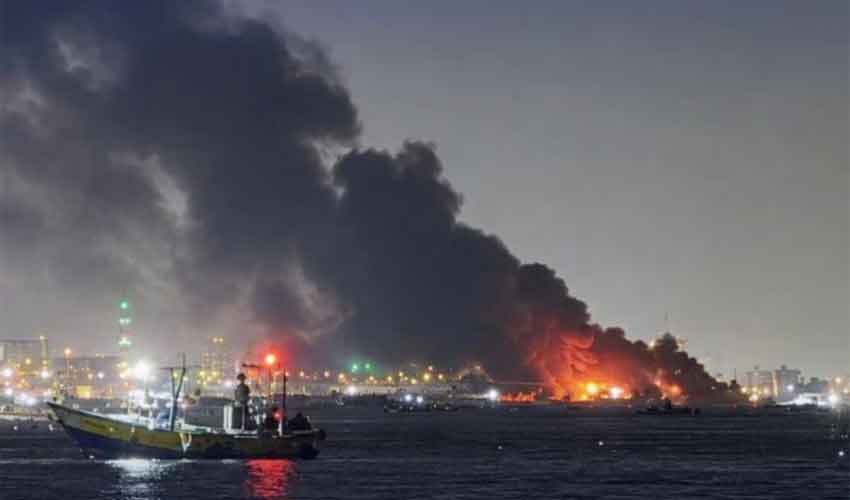
Iranian media also claimed that several people were injured by shell fragments from an “enemy projectile” at the commercial port of Sirik. The injured were transferred to a hospital in Minab, but no further details were provided about the number of casualties.
A fire was also reported at a fishing pier in Bandar Abbas, where several boats were affected. Iranian media said black smoke in the area was caused by enemy projectiles.
Iran’s Press TV earlier reported that several explosions had been heard in the southern Iranian port city of Sirik, but initially gave no details about the cause, casualties or damage.
Explosions reported in Sirik, Bandar Abbas
Iranian media reported that five explosion sounds were heard around Sirik in southern Iran. The reports said explosions were heard after commercial and fishing piers were hit.
State media also reported explosions in the east and west of Bandar Abbas. Later, Iranian state media said explosions were also heard on Qeshm Island.
On Wednesday, Press TV reported renewed explosions on Qeshm Island and said several blasts were also heard on Kharg Island in southern Iran. The report did not immediately provide details about the cause of the explosions, possible damage or casualties.
Kharg Island is a key energy hub, with Iran exporting around 90% of its crude oil through the island.
Iranian state TV, citing a local official, said no civilian deaths had been reported so far.
CENTCOM says more than 80 targets hit
US Central Command said on Tuesday that American forces had completed a new round of offensive strikes against Iran, hitting more than 80 targets with precision munitions.
CENTCOM said the strikes were launched in response to what it described as Iran’s latest attacks on commercial vessels transiting the Strait of Hormuz.
— U.S. Central Command (@CENTCOM) July 8, 2026
According to the US military, American forces struck Iranian air defense systems, command and control networks, coastal radar sites, anti-ship missile capabilities and more than 60 Islamic Revolutionary Guard Corps small boats in and near the strait.
CENTCOM said the purpose of the strikes was to degrade Iran’s ability to continue attacking international commerce flowing through the international trade corridor.
It added that US forces remained ready to hold Iran accountable if the agreement was not followed.
US says strikes followed attacks on tankers
The latest escalation came after three tankers reported being struck by unknown projectiles in and near the Strait of Hormuz in recent days, according to the British navy-affiliated agency UKMTO.
Sources told Reuters that a Qatari LNG tanker was at risk of exploding and that a Saudi-flagged crude oil tanker had been damaged near the strait.
There was no claim of responsibility for the attacks. However, a US official, speaking on condition of anonymity, said initial indications suggested that Iran had fired at two commercial vessels.
A US official also said Iran had launched three separate attacks on Monday and Tuesday against commercial ships in the Strait of Hormuz.
US revokes Iran oil sales license
Alongside the latest wave of strikes, Washington revoked a license that had allowed Iran to sell oil.
The move came after the three tankers were hit by projectiles in or near the Strait of Hormuz.
Iran’s Foreign Ministry condemned the US decision to revoke the sanctions waivers, saying Washington had breached the terms of the memorandum of understanding.
The Treasury Department announced the revocation shortly before the US military retaliation.
A US official told Reuters that the latest strikes targeted Iranian air defense systems, coastal surveillance systems, surface-to-air missiles, anti-ship cruise missiles and drone launch sites.
A separate US official told Axios that the targets also included port facilities.
The official said Tuesday’s strikes were four to five times bigger in scope and power than previous US strikes in the Hormuz area 10 days ago.
Trump approved strike plan in Turkey, official says
A US official told Axios that President Donald Trump approved the strike plan and ordered the operation while he was in Turkey for this week’s NATO summit.
Trump held a meeting in Ankara with Defense Secretary Pete Hegseth, Secretary of State Marco Rubio and Treasury Secretary Scott Bessent, who had flown with him on Air Force One.
They were joined by Joint Chiefs of Staff Chairman Gen. Dan Caine and other officials who were already on the ground for the NATO summit.
The US official said the response was a direct result of what Washington described as acts of international terrorism against innocent ships transiting the Strait of Hormuz.
Iran vows ‘crushing response’
Iran’s top joint military command accused Washington of a “blatant act of aggression” and said Iranian armed forces would deliver a “crushing response.”
The Iranian military said Tehran would not allow US interference in the management of the Strait of Hormuz.
It also said the only safe route for commercial ships and oil tankers was the route set by Iran.
Iran’s top negotiator, Mohammad Bagher Ghalibaf, accused the United States of major violations of the memorandum of understanding.
Writing on X, Ghalibaf said the era of bullying and extortion was over, adding that Tehran would not back down.
Drones reported toward Bahrain
Amid the escalation, a US official said the Iranian military had launched drones at Bahrain.
The report came as the wider region remained on edge due to renewed hostilities around the Strait of Hormuz, one of the world’s most important energy corridors.
Kuwait reports power outages
The Kuwaiti Ministry of Electricity said the country’s electricity transmission system had been affected. Several power lines were down, leading to power outages and load shedding in different parts of Kuwait.
The latest strikes come after a preliminary peace agreement was reached last month and amid ongoing talks aimed at ending the more than four-month-old war.
The war began on February 28, when the United States and Israel attacked Iran. Tehran later responded with strikes on Israel and Gulf states hosting US military bases.
The US-Israel strikes on Iran and Israeli attacks on Lebanon during the war have killed thousands and displaced millions.
The conflict has also pushed up oil prices and shaken financial markets around the world.
CENTCOM said in an earlier statement that the powerful strikes were intended to impose heavy costs for targeting commercial shipping crewed by innocent civilians in an international waterway.
It described Iran’s actions as unwarranted, dangerous and a clear violation of the ceasefire.