A football made in Pakistan has achieved a unique milestone beyond the football field — it has reached space.
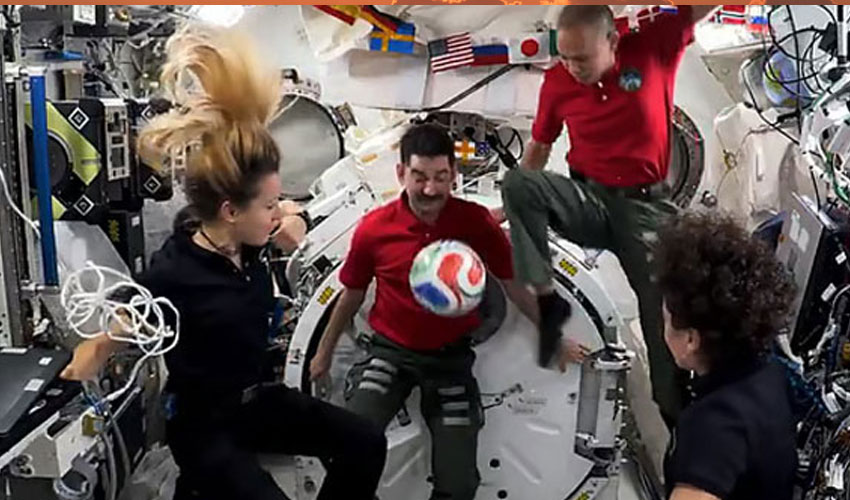
Astronauts aboard the International Space Station (ISS) recently conducted a scientific experiment using the official FIFA World Cup 2026 football to study how it behaves in a weightless environment.
The official FIFA World Cup 2026 football, known as the Trionda, was used by NASA astronauts during an experiment aboard the ISS.
The test took place inside the station's Cupola module, where astronauts observed the ball floating in microgravity conditions.
The football, designed by Adidas and manufactured in Pakistan, is the official match ball for the 2026 FIFA World Cup.
What was NASA studying?
NASA said the experiment was designed to examine how the balance and weight distribution of a football influence its movement when gravity is removed from the equation.
By observing the ball's motion in space, researchers hope to gain a better understanding of how design characteristics affect performance and trajectory.
The agency noted that a similar experiment was also conducted in 2019, which demonstrated that even small differences in balance can significantly impact how a football moves.
The experiment was carried out aboard the International Space Station, where astronauts experience continuous microgravity.
The Cupola module, known for its large panoramic windows, provided an ideal setting for monitoring the football's movement in a weightless environment.
What does ‘Trionda’ mean?
According to FIFA, the name "Trionda" is derived from a Spanish term meaning "three waves."
The name reflects the historic nature of the 2026 FIFA World Cup, which will be jointly hosted by three countries: United States, Canada and Mexico.
The tournament will be the first FIFA World Cup hosted by three nations.
Pakistan has long been recognized as a major producer of high-quality footballs, with the city of Sialkot supplying footballs for some of the world's biggest sporting events.
The use of the Pakistan-manufactured FIFA 2026 match ball in a NASA experiment highlights the global reach of the country's sporting goods industry and adds another achievement to its football-making legacy.