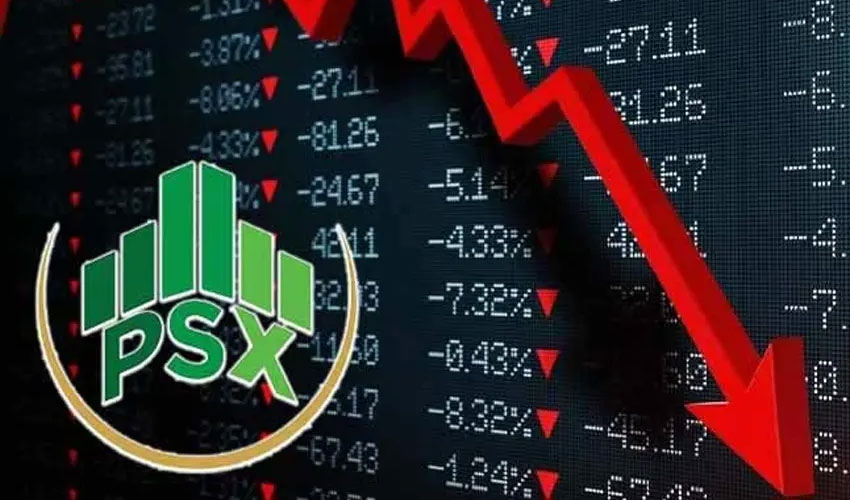
The Pakistan Stock Exchange (PSX) witnessed another sharp plunge today, with the KSE-100 Index shedding over 13,000 points.
Trading was briefly suspended under circuit breaker rules as investors reacted to escalating Middle East tensions and soaring global oil prices.
The first day of the trading week started with significant selling pressure. The KSE-100 Index opened sharply lower, losing 9,780 points to hover around 147,715 by 9:22am. This triggered a Market Halt under PSX regulations, which mandate suspension if the KSE-30 Index falls by 5% for five consecutive minutes.
Trading resumed after a 45-minute halt at 10:22am, but the negative trend continued. By 10:55am, the KSE-100 Index had dropped further to 144,386 points, a decline of over 13,100 points or 8.32%.
PSX rules trigger market halt
The PSX circuit breaker law aims to prevent panic selling. Trading is automatically suspended if the KSE-30 Index experiences a 5% fall over five consecutive minutes. Today’s drop activated this law for the second time this month, reflecting the heightened volatility in the market.
Even after the resumption, the market continued to fall, with shares across all sectors trading in the red. The previously important threshold of 150,000 points was broken as investor confidence waned.
The sharp drop today follows another week of losses. Last week, the KSE-100 Index fell by 10,566 points, closing at 157,496 compared to 168,062 the previous week. During that week, 3.28 billion shares were traded with a total market capitalization decline of Rs 1,231 billion to Rs 17,698 billion.
Factors Driving the Market Downturn
Experts attributed the PSX crash to a combination of geopolitical tensions, soaring oil prices, and macroeconomic uncertainty.
An expert stated, “Markets react swiftly to risk, and the current environment has triggered a defensive shift toward liquidity and capital preservation. Restoring investor confidence will require de-escalation of regional tensions.”
Impact on key sectors
Across-the-board selling pressure was observed in major sectors, including automobiles, cement, commercial banks, oil and gas exploration, OMCs, and power generation. Heavyweight stocks such as MCB, MEBL, NBP, MARI, OGDC, PPL, PSO, SNGPL, SSGC, and HUBCO traded in the red.
International markets also reacted sharply. Brent crude surged 23% to $114.36 per barrel, while US crude rose 27% to $115.11, triggering concerns about inflation and energy costs worldwide. Asian markets including Japan, South Korea, and China saw significant declines as investors sought liquidity amid uncertainty.
The recent appointment of Mojtaba Khamenei as Iran’s new Supreme Leader has heightened geopolitical risks. Coupled with ongoing conflict involving the US and Israel, the market remains highly sensitive to developments in the Middle East.
Experts warn that continued unrest could sustain elevated risk premiums across commodities and equities, keeping markets volatile in the near term.


.jpg)


.jpg)