





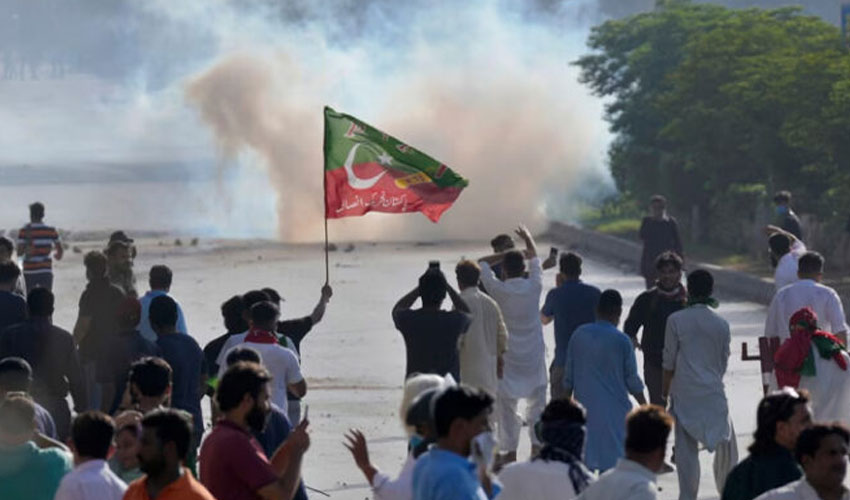
A court in Rawalpindi has sentenced 47 accused, including several senior leaders of the Pakistan Tehreek-e-Insaf (PTI), to 10 years in prison in the May 9 General Headquarters (GHQ) attack case.
The court also imposed a fine of Rs5.5 million on each of the convicted individuals.
The verdict was delivered by Amjad Ali Shah, judge of the Rawalpindi Anti-Terrorism Court, in connection with the violence that erupted on May 9 riots in Pakistan.
The court ruled that the convicted individuals had played a central role in the events and were involved in planning violent protests that targeted sensitive military installations.
Prominent PTI leaders among convicted
Among those sentenced to 10 years in prison are several prominent PTI leaders, including Omar Ayub Khan, Zartaj Gul, Murad Saeed, Shibli Faraz, Hammad Azhar, and Kanwal Shauzab.
Other convicted individuals include Shahbaz Gill, Rashid Shafiq, Zulfi Bukhari, Muhammad Ahmed Chatha, Rai Hassan Nawaz, Rai Muhammad Murtaza, Shaukat Ali Bhatti, Usman Saeed Basra and Ijaz Khan Jazi.
The court also ordered the seizure of the properties of the convicted individuals.
According to the court verdict, the accused were involved in attacks on key military-related sites in Rawalpindi, including GHQ Gate, Hamza Camp and the Army Museum.
The court found that the accused participated in acts of violence, including attacking police personnel, damaging government property and carrying out arson during the unrest.
Trial proceedings
The case originally named 118 accused, including PTI founder Imran Khan and senior party leader Shah Mahmood Qureshi, who were indicted in December 2024.
During the proceedings, the court recorded statements from 44 prosecution witnesses. However, several of the accused did not appear during the trial process.
Out of the total accused, 18 were absent during hearings, while 29 never appeared before the court after the case was registered.
A separate trial was conducted for 47 accused who had been declared absconders under the Anti-Terrorism Act.
On January 6 this year, the prosecution filed a petition seeking action against these declared absconders. Following this, the court initiated an inquiry.
Advertisements were issued on January 8 giving the accused seven days to appear before the court. However, none of them appeared, prompting the court to appoint state counsel to represent them.
The prosecution presented statements of 19 witnesses during this phase, and the state-appointed lawyers cross-examined them before the proceedings concluded.










.jpg)
.jpg)







