Venezuela’s deposed leader Nicolas Maduro was transferred under heavy security to a federal court in Manhattan on Monday, where he is due to face US drug-related charges amid mounting international controversy.
US authorities moved Maduro from the Metropolitan Detention Center in Brooklyn to Manhattan ahead of his scheduled appearance before US District Judge Alvin K. Hellerstein at around noon local time (17:00 GMT).
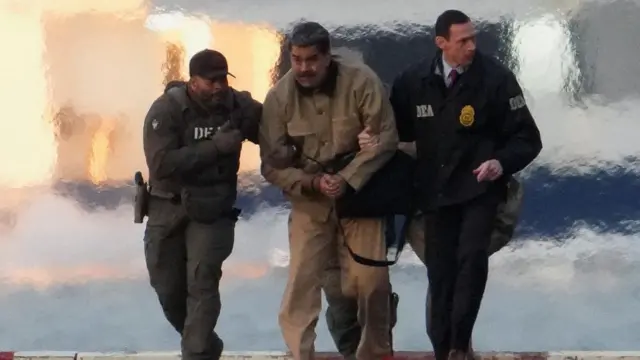
Television footage showed Maduro stepping off a helicopter in Manhattan alongside a woman believed to be his wife, Cilia Flores. Both were escorted by multiple Drug Enforcement Administration (DEA) agents and appeared to be wearing prison attire, with Maduro seen limping slightly.
Charges, court appearance in New York
Maduro, 63, is accused by US prosecutors of overseeing a cocaine-trafficking network allegedly linked to Mexico’s Sinaloa and Zetas cartels, Colombia’s FARC rebels, and Venezuela’s Tren de Aragua gang.
He has long denied the allegations, insisting they are politically motivated and tied to US interest in Venezuela’s vast oil reserves.
Maduro’s transfer follows what US officials have described as a high-risk operation in Caracas over the weekend, when American Special Forces allegedly captured him during a helicopter raid.
The operation has drawn widespread international attention, with the United Nations Security Council expected to scrutinize its legality. Russia, China, Cuba, and other leftist allies of Venezuela have condemned the move, while several US allies have urged restraint and adherence to international law.
Venezuela’s interim leadership softens tone
Following initial condemnation of Maduro’s capture as a “kidnapping,” Venezuela’s acting president Delcy Rodriguez signaled a shift in tone on Sunday.
She called for a “balanced and respectful” relationship with Washington during the transition of power, urging cooperation rather than confrontation. Rodriguez remains a key figure within the ruling Chavista movement, even as Maduro is held in US custody.
US President Donald Trump has defended the operation, describing Maduro as a dictator and drug kingpin and claiming the United States is now “in charge” of Venezuela.
Trump has openly linked the move to curbing drug trafficking, addressing migration pressures, and reopening Venezuela’s oil sector to US companies. He has warned of further action if Caracas does not cooperate.
Uncertainty inside Venezuela
Inside Venezuela, the situation remains tense but calm. While some opponents of Maduro have welcomed the development, celebrations have been muted as senior officials from his government remain in control and the military has not shifted its stance.
Many Venezuelans have reportedly begun stocking up on food and medicine, fearing potential instability in the days ahead.