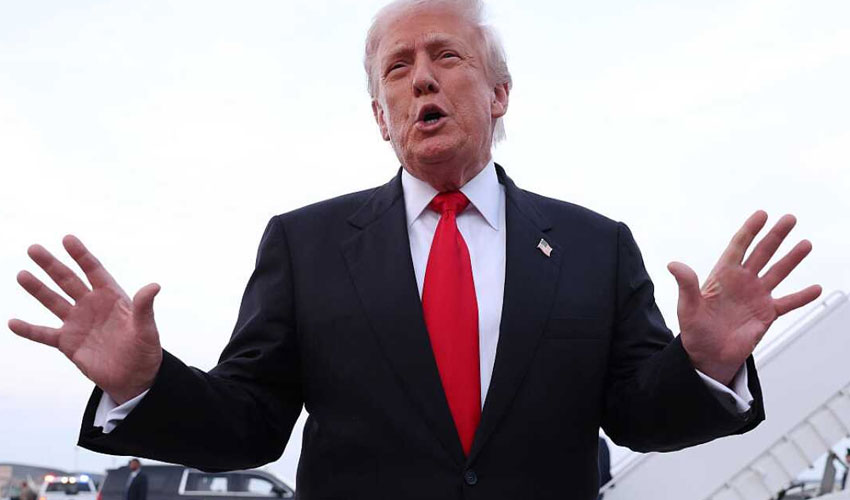
Tens of thousands of protesters rallied in cities across the United States on Saturday, voicing their opposition to President Donald Trump as he presided over a rare and extravagant military parade in the nation’s capital.
The demonstrations, organised by a grassroots group named No Kings, were held in response to what critics described as an attempt by Trump to project authoritarian power under the guise of a patriotic celebration. The military parade coincided with the president’s birthday and marked the 250th anniversary of the US Army.
Protesters gathered in major cities including New York, Philadelphia, Los Angeles, and Houston, waving American flags and carrying placards condemning Trump’s immigration policies and alleged overreach of executive authority.
In Philadelphia’s Love Park, 61-year-old nurse Karen Van Trieste told the Associated Press that she felt compelled to defend American democratic values. “Trump’s cuts to public health agencies are unacceptable. We need to take a stand,” she said.
One of the largest demonstrations took place in Los Angeles, a city already on edge after days of unrest linked to immigration enforcement operations. President Trump’s deployment of the National Guard to the state—over objections from California Governor Gavin Newsom—has further fuelled tensions.
In Los Angeles, confrontations broke out near the Federal Building where civil rights activists, including members of the Brown Berets, clashed with National Guard troops. Tear gas was fired to disperse the crowd, although peaceful marches continued just blocks away.
Jose Azetcla, a Brown Berets member, told the BBC he had joined the protests to challenge the administration’s immigration raids. “We’re out here because our communities are under attack,” he said.
Despite the scale of the protests, recent polls suggest that Trump’s immigration agenda continues to enjoy considerable public support. A CBS/YouGov survey conducted last week found that 54% of Americans supported his policy of deporting undocumented immigrants, while 46% opposed it. Moreover, 53% believed his administration was prioritising the removal of dangerous criminals.
The name No Kings was chosen by organisers to highlight what they see as Trump’s disregard for the constitutional limits of presidential power during his second term.
Back in Washington, the president stood saluting as tanks, military vehicles, and thousands of uniformed troops paraded past. Military bands added to the spectacle, which critics decried as a costly display of militarism. Estimates put the cost of the event between $25 million and $45 million, according to figures from the US Army.
Addressing the audience briefly, President Trump praised the armed forces: “Our soldiers never give up. Never surrender and never, ever quit. They fight, fight, fight. And they win, win, win.”
While several lawmakers and former military officials condemned the parade as a politically motivated vanity project, others in attendance expressed a different view.
Melvin Graves, a Vietnam War veteran, said he came to honour those who served. “I never got a parade when I came back,” he said. “This is the closest I’ll ever get. Yes, politics are involved, but today, for me, it’s about showing respect.”
.jpg)