A major dispute has erupted in world football after UEFA and its 55 member associations unanimously voted to boycott FIFA competitions if the governing body moves ahead with plans to bring private investors into the World Cup.
The proposal has triggered strong opposition from football confederations across multiple continents, setting the stage for one of the biggest governance battles in the sport's history.
European football's governing body, UEFA, and all 55 of its member associations voted unanimously to reject FIFA's proposal to transfer ownership interests in the World Cup and other FIFA competitions to private investors.
According to a Reuters source, the emergency meeting ended with a 55-0 vote in favour of a boycott. UEFA warned that no European national team would participate in any FIFA competition as long as the proposal remains active, unless it is completely abandoned and FIFA provides binding guarantees that it will never again seek private ownership of its competitions.
In a strongly worded statement, UEFA said the World Cup "is not for sale" and cannot be treated as an investment product or handed over to private investors.
FIFA's investment proposal sparks controversy
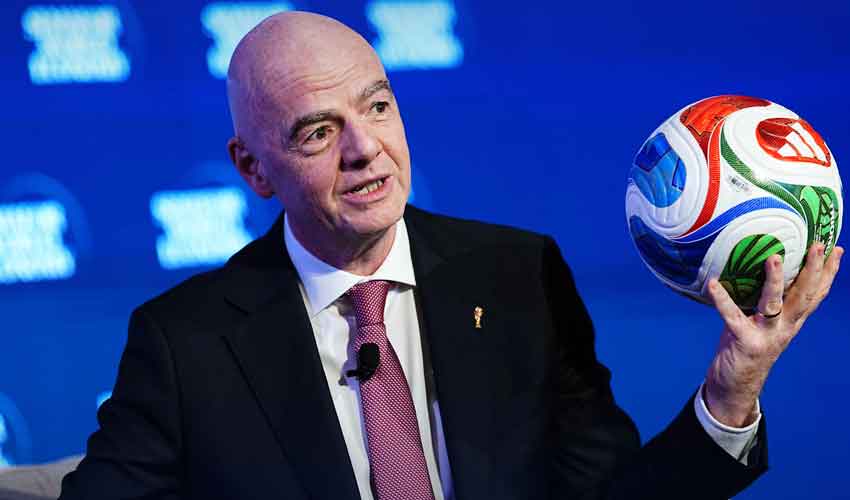
The proposal, unveiled by FIFA President Gianni Infantino earlier this week, would establish a new $20 billion subsidiary called FIFA Forward Enterprise (FFE) to manage the commercial rights of the FIFA World Cup and other FIFA tournaments.
Under the plan, FIFA would sell up to a 20% stake in the subsidiary to external investors. FIFA said investment firm Thrive Eternal, managed by Thrive Capital founder Joshua Kushner, is expected to lead the proposed investor group. Joshua Kushner is the brother of Jared Kushner, the son-in-law of U.S. President Donald Trump.
Infantino also proposed distributing $40 million to each of FIFA's 211 member associations if they approve the plan by September 19 as part of a $10 billion funding package scheduled to become available from January 1, 2027.
If member associations reject the proposal, FIFA said the funding package would revert to the previously planned $2.7 billion, or roughly $10 million per association.
FIFA vows to continue consultations
Despite the backlash, FIFA said on Friday it would proceed with consultations, arguing that "incorrect media reports" had disrupted its planned process.
The Switzerland-based governing body stressed that every member association should have the opportunity to review the proposal before voting.
"We will proceed with this consultation process to ensure that each Member Association has the ability to express its vote based on facts," FIFA said.
Responding directly to UEFA's criticism, FIFA rejected claims that football was being sold to private investors.
"Nobody is selling football. This is not something FIFA would ever entertain," the governing body said.
FIFA also argued that no single confederation could claim to represent all 211 member associations and described the consultation as a democratic process.
The organization emphasized that the proposal would only move forward if it receives majority support from its member associations.
UEFA is not alone in opposing the proposal.
The Confederation of North, Central America and Caribbean Association Football (CONCACAF), representing 41 member associations, rejected FIFA's proposal during a meeting on Thursday.
However, Mexico's Football Federation later clarified that it has not reached a final decision and intends to review further documentation and participate in FIFA's planned round-table discussions before announcing its position.
The Asian Football Confederation (AFC), representing 47 member associations, also criticized the proposal.
In a strongly worded letter to its members, the AFC questioned whether the plan could succeed without the backing of all six continental confederations. On Friday, it said it stands in solidarity with UEFA and CONCACAF while stopping short of announcing a boycott.
The AFC also raised concerns about FIFA's decision-making process in what appeared to be a thinly veiled criticism of President Gianni Infantino.
Together, UEFA, CONCACAF and the AFC represent 143 of FIFA's 211 member associations, giving the opposition significant influence, although individual national federations may still vote independently.
Some federations remain open to discussions
Not every football association has fully aligned with the regional opposition.
Czech Football Association President David Trunda said he could see the "positive impact of FIFA's intentions," suggesting some member associations remain open to discussing the proposal.
Similarly, the Mexican Football Federation reiterated that it would examine FIFA's documentation before making a final decision.
Potential impact on future World Cups
UEFA's boycott threat has immediate implications for upcoming FIFA tournaments.
Brazil is scheduled to host the 2027 FIFA Women's World Cup, while Spain and Portugal will co-host the 2030 FIFA Men's World Cup alongside Morocco.
Europe remains the strongest force in international football, with six of the world's top 10 ranked men's and women's national teams coming from the continent, including reigning world champions Spain.
A boycott by UEFA would significantly affect the competitiveness and commercial value of future FIFA competitions.
The debate has also drawn reactions from prominent figures in football.
Chelsea head coach Xabi Alonso, who won the 2010 FIFA World Cup with Spain, said football must remain focused on supporters rather than commercial interests.
"The way we love football is like this, and we have just seen a great World Cup," Alonso said. "We have to defend the interests of all the people."
He added that football belongs to everyone and expressed hope that the sport would remain authentic, saying preserving its passion and emotional connection with fans should remain the highest priority.
Defining moment for football governance
The dispute has become one of the biggest governance challenges FIFA has faced in recent years.
While FIFA argues that the proposal would unlock unprecedented development funding and provide commercial opportunities for member associations, its critics believe introducing private ownership into the World Cup could fundamentally change the nature of the sport.
With the September 19 deadline approaching, football's governing bodies now face a decision that could reshape the future of the World Cup and international football for decades.