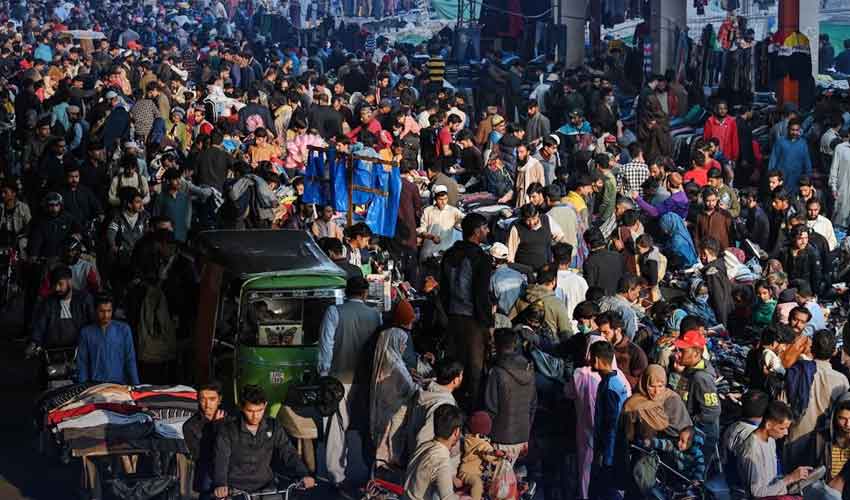
Pakistan’s growing population is no longer only an economic and social concern. It is now closely linked to climate change, environmental pollution, urban pressure and a serious public health crisis.
With the country’s population exceeding 240 million, experts say rising demand for transport, housing, food, electricity and infrastructure is placing unprecedented pressure on the environment.
Pakistan’s population is increasing by millions every year.
As the number of people grows, the demand for vehicles, factories, fuel, electricity, housing and urban infrastructure also rises. These factors directly contribute to higher carbon emissions and pollution.
According to experts, the energy sector contributes about 40% to Pakistan’s total greenhouse gas emissions. Agriculture contributes around 25%, while transport accounts for nearly 20%.
The growing population is increasing pressure on all these sectors, causing emissions to rise continuously.
Housing expansion, tree cutting worsen heat
Rapid population growth has also increased the demand for residential projects.
As cities expand, trees are being cut to make space for housing schemes and infrastructure. The loss of greenery is contributing to rising temperatures across the country.
This trend is pushing Pakistani cities toward the urban heat island effect, where concrete-heavy urban areas become significantly hotter than surrounding rural regions.
As a result, heat intensity, heat waves and electricity demand are all increasing.
Air pollution becomes major threat
Pakistan is now among the countries where air pollution has become a serious health risk. According to the World Health Organization, air pollution can cause heart disease, stroke, lung cancer, asthma and other respiratory illnesses.
Experts warn that if population growth is not managed through sustainable planning, Pakistan’s environmental and healthcare challenges could become far more severe.
Population may reach 500m by 2050
Minister of State for National Health Dr Mukhtar Ahmed Bharath has warned that Pakistan’s population could reach 500 million by 2050.
Speaking to Samaa TV, he said rapid population growth is the root of several major national problems. Dr Bharath said Pakistan is the fifth-largest country in the world by population, with around 6 million children born every year.
The minister said spacing between childbirths is essential for the health of mothers and the wellbeing of the entire family. He linked child stunting in Pakistan to rapid population growth, saying unchecked population expansion affects nutrition, healthcare and family stability.
Dr Bharath warned that Pakistan’s resources will shrink in proportion to such a rapid rise in population.
Resources under pressure as cities expand
The minister said the population of Pakistan’s cities has increased rapidly over the last 20 to 25 years. He said Islamabad’s population has grown from around 400,000 to 4 million, creating major pressure on services and administration.
According to him, the populations of Lahore and Karachi have also gone out of control, making administrative measures more difficult in major urban centres.
Dr Bharath said Punjab Chief Minister Maryam Nawaz is paying special attention to rural development. He said facilities are being provided in villages so that population pressure on cities can be reduced.
The minister urged other provinces to follow the same approach and improve basic facilities in rural areas to slow the movement of people toward major cities.
Govt action alone not enough
Dr Bharath said reducing the population growth rate is necessary to speed up economic development. He warned that without controlling population growth, it will not be possible to provide basic facilities such as food, education and healthcare to people.
He added that managing health, education and food for a population of 500 million will not be easy.
The minister said government measures alone cannot solve the population challenge, and the public must also play its role.
Karachi struggles under population pressure
Karachi, once known as the city of lights, is now facing severe pressure from unchecked population growth. Over the last few decades, the city’s population has increased by millions, but basic facilities have not expanded at the same pace.
Water shortages, poor infrastructure and the rapid spread of slums have made daily life difficult for residents and damaged the city’s urban landscape.
In 1998, Karachi’s population stood at 9,856,318. By 2023, it had risen to 20,382,881, meaning the city’s population more than doubled in just over two decades.
Experts say the increase is due to both natural population growth and the arrival of people from across Pakistan in search of work, housing and better opportunities.
Unplanned growth creates serious problems
This uncontrolled population growth has left Karachi directionless, according to experts. The city is facing severe water shortages, pressure on infrastructure and growing housing problems.
Experts say federal, provincial and municipal governments have not given Karachi its due share of planning, investment and governance.
Experts say the city’s master plan has not been properly implemented. Karachi’s housing shortage has now reached around one million units, worsening pressure on low-income communities.
The number of slums in the city has exceeded 400, creating a major challenge for urban planning, economic equality and government performance.
Rapidly expanding informal settlements have become a serious test for Karachi’s future.



.jpg)