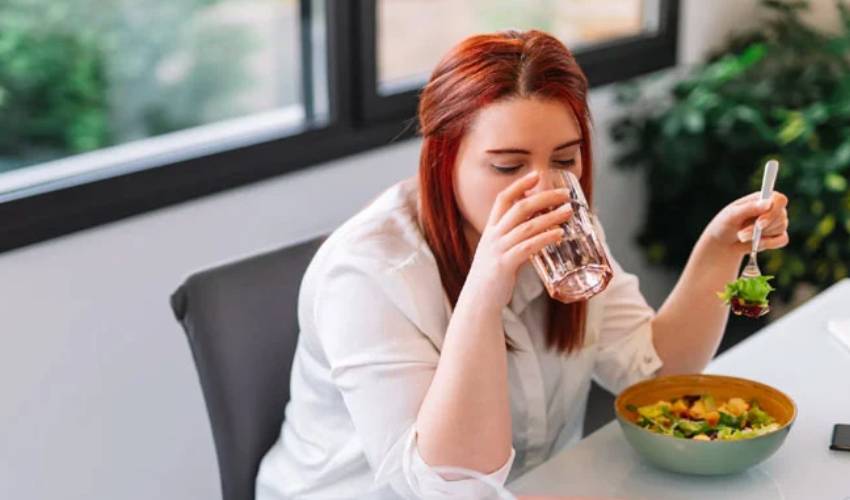
Drinking water during meals may encourage people to eat more rather than less, according to a new study by researchers from Cornell University and Penn State University, challenging the long-held belief that water helps reduce appetite.
The findings, published in the scientific journal Appetite, are based on an analysis of data from two experiments involving 86 adults.
Researchers examined participants' eating habits while they consumed either beef chili or chicken tikka masala, served with water. Participants were allowed to eat as much as they wished, while their meals were recorded on video to monitor their drinking behaviour.
More water linked to larger meals
The researchers analysed several factors, including the number of sips participants took, the size of each sip, how quickly they drank water and how often they alternated between bites of food and sips of water.
The results showed that participants who drank more water also consumed more food.
For every additional 100 grams of water, participants ate an average of 39 grams more food, equivalent to approximately 49 extra calories.
Similarly, people who switched more frequently between bites and sips also tended to eat larger portions. Each additional alternation was associated with an average increase of 4.4 grams of food consumed.
Why does water increase food intake?
Researchers believe frequent sips of water may delay the body's natural feeling of fullness, a process known as sensory-specific satiety.
Normally, continuously eating the same food gradually reduces its appeal, helping people stop eating.
Lead author Dr Paige Cunningham, assistant professor of nutritional sciences at Cornell University, said drinking water repeatedly during a meal may refresh the taste of food, making it remain enjoyable for longer.
"Repeated sips of water may restore flavour perception, allowing people to continue enjoying their food and eat for a longer period," she explained.
Challenges common advice
Many people believe drinking water fills the stomach and helps reduce food intake.
However, researchers noted that water leaves the stomach relatively quickly, meaning it may not produce a lasting feeling of fullness.
Instead, water may make eating easier by lubricating food, preventing the mouth from drying out and helping people eat at a faster pace, potentially leading to greater overall food consumption.
More research needed
The scientists cautioned that the study was conducted on a relatively small group of participants and its findings may not apply to every type of meal or eating situation.
They said further research involving larger populations and a wider variety of foods is needed before drawing broader conclusions.