China has reaffirmed its strong support for Iran's sovereignty and called for an early resumption of negotiations to ease growing tensions in the Middle East, as Iranian Foreign Minister Abbas Araghchi held high-level talks with his Chinese and Russian counterparts during the Shanghai Cooperation Organization (SCO) foreign ministers' meeting.
The meetings came amid escalating hostilities between the United States and Iran, with Beijing urging all parties to return to dialogue and implement the Islamabad Memorandum of Understanding (MoU) aimed at ending the conflict.
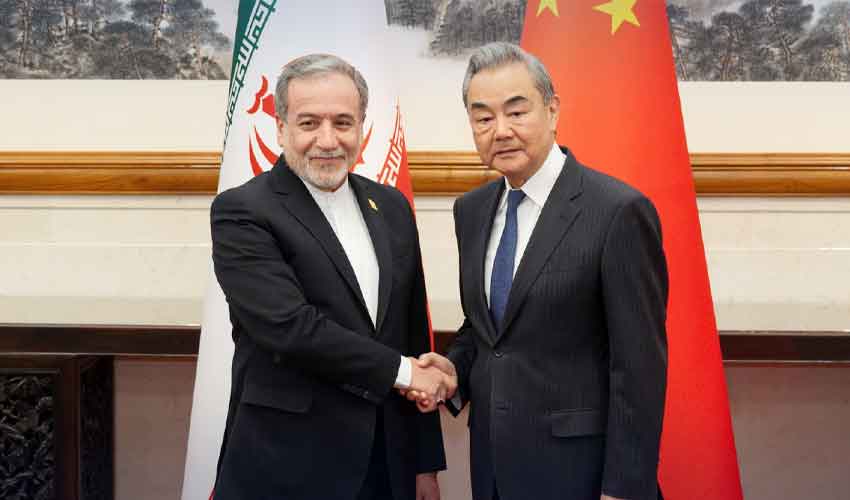
Chinese Foreign Minister Wang Yi met Iranian Foreign Minister Seyed Abbas Araghchi on the sidelines of the SCO Council of Foreign Ministers meeting in Cholpon-Ata, Kyrgyzstan.
Wang, who is also a member of the Political Bureau of the Communist Party of China Central Committee, expressed China's deep concern over the renewed escalation in the Middle East and Gulf region.
He described the Islamabad Memorandum of Understanding, signed more than a month ago, as a valuable outcome of multilateral mediation efforts that reflected the aspirations of the Iranian people and the wider region for peace and stability.
Also Read: Trump says US, Iran talking; Tehran insists won't bow to pressure
"The door to negotiations, once opened, should not be closed, and as long as there is hope for peace, it should not be given up," Wang said.
He stressed that the immediate priority is to resolve differences through dialogue, resume implementation of the MoU, and return to the consensus previously reached.
Beijing rejects Trump's narrative, calls Iran strategic partner
China also rejected claims attributed to US President Donald Trump regarding Iran, reiterating that Tehran remains Beijing's comprehensive strategic partner.
Wang said China firmly supports Iran in safeguarding its sovereignty, security, and national dignity.
He added that Beijing would continue to work in line with its four-point proposal for peace in the Middle East, support mediation efforts led by Pakistan and other parties, facilitate the early resumption of negotiations, help address issues related to the Strait of Hormuz, improve relations among neighbouring countries, promote collective Gulf security, and contribute to restoring regional peace and stability.
Araghchi says Iran still wants negotiations
During the meeting, Araghchi briefed Wang on the latest developments in the Middle East and Gulf region, emphasizing that Iran's willingness to negotiate remains unchanged.
He said Tehran does not want the conflict to continue and urged the United States to honor its commitments, exercise restraint, cooperate with Iran, and pursue a reasonable diplomatic solution.
Araghchi also stressed that Iran and China, as comprehensive strategic partners, should strengthen communication and coordination during what he described as a critical period.
Also Read: Trump says Xi, Putin assured him they won't supply weapons to Iran
He thanked China for maintaining what he called an objective and impartial position and expressed hope that Beijing would continue playing a constructive role in reducing regional tensions.
Iran consults Russia, China on regional crisis
Alongside his meeting with Wang Yi, Araghchi also held talks with Russian Foreign Minister Sergey Lavrov as Tehran intensified consultations with its key international partners over the worsening regional situation.
The discussions focused on the latest developments following recent US military actions and the broader security situation in the Middle East.
Iranian officials accused the United States of violating previously agreed commitments and warned that Washington's actions had further destabilized the region.
Also Read: Iraq rejects report claiming it brokered US-Iran ceasefire proposal
The Iranian Foreign Ministry said the United States would not be allowed to misuse the Strait of Hormuz and held Washington responsible for growing instability around the strategically important waterway.
Iran reiterated that protecting its interests and rights in the Strait of Hormuz remains a fundamental national priority.
Islamabad MoU remains central to peace efforts
Wang said the Islamabad Memorandum of Understanding remains the best available framework for reducing tensions and should not be abandoned.
He emphasized that implementing the agreement and returning to negotiations is now an urgent task.
Also Read: US missiles hit Iran as path towards de-escalation uncertain
China also reiterated its support for Pakistan's diplomatic mediation efforts, saying it would continue working with Islamabad and other regional stakeholders to encourage dialogue and peaceful conflict resolution.
Regional tensions have intensified over the past two weeks after US President Donald Trump announced on July 8 that the ceasefire established under the Islamabad Memorandum of Understanding was no longer in effect.
Since then, the United States and Iran have exchanged military strikes, with Washington targeting sites inside Iran while Tehran says it has launched attacks on US military facilities and equipment across several countries in the region.
The renewed hostilities have increased international concerns over stability in the Middle East and the security of vital global shipping routes.