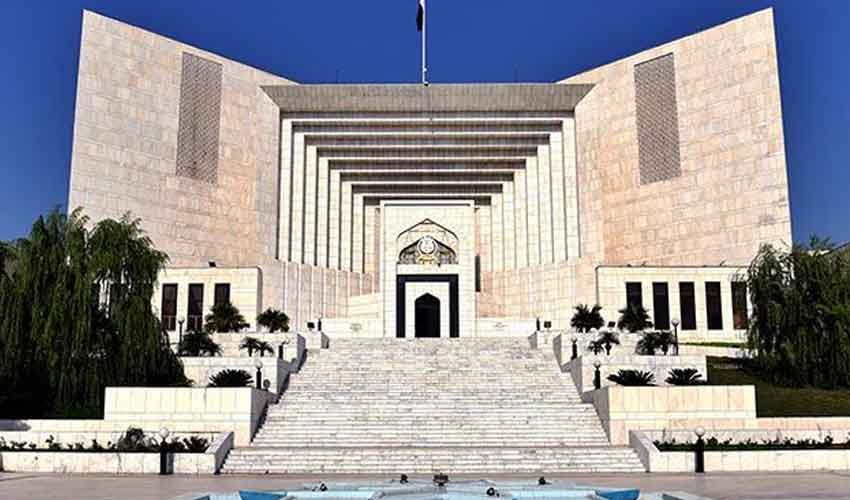
The Supreme Court has clarified that it no longer has the authority to hear appeals and bail applications in National Accountability Bureau (NAB) cases, following recent legal amendments.
The ruling means all pending NAB-related cases, including PTI founder Imran Khan's appeal in the £190 million reference, will now be heard by the Federal Constitutional Court.
A three-member bench headed by Justice Muhammad Ali Mazhar delivered the ruling on an important constitutional question concerning the forum for appeals and bail in NAB cases.
The court held that the Supreme Court no longer has jurisdiction over such matters and that the Federal Constitutional Court is now the legally designated forum for hearing appeals and bail applications under the amended NAB law.
Constitutional amendments and NAB law
According to the judgement, the bench examined the recent amendments to the NAB laws, along with Articles 175A and 175F of the Constitution and Section 32 of the National Accountability Ordinance.
Based on this review, the court directed that all pending appeals and related NAB matters be transferred to the Federal Constitutional Court.
The ruling also makes it clear that all future final appeals in NAB cases will be heard by the Federal Constitutional Court.
Pending NAB cases to be transferred
Following the decision, all pending NAB appeals, including bail and sentence-related matters, will be shifted to the Federal Constitutional Court.
Among the cases affected is PTI founder Imran Khan's application for suspension of sentence in the £190 million reference, which had been filed before the Supreme Court.
The court's ruling also applies to the chamber appeal filed after objections were raised by the Supreme Court Registrar regarding that petition.
Court explains why Supreme Court cannot retain bail jurisdiction
The judgement noted that some lawyers had argued the Supreme Court had previously granted bail in a NAB case even after amendments to the accountability law.
However, the bench observed that NAB had not challenged the court's jurisdiction in that particular case, adding that only NAB could explain why no objection was raised at the time.
The court emphasized that the law clearly identifies the Constitutional Court as the forum for appeals, and therefore allowing the Supreme Court to retain jurisdiction over bail applications would be contrary to the intent of the law.
It further stated that the forum for appeal is determined by legislation itself and does not depend on the consent or objections of any party.
March amendments shifted final appellate forum
The ruling follows amendments introduced by the federal government in March this year, under which the Federal Constitutional Court was designated as the final appellate forum for NAB cases.
The Supreme Court's decision formally reinforces those amendments and establishes that all future appeals and bail matters under the NAB law must be heard by the Constitutional Court.
Detailed judgement still awaited
While the Supreme Court has announced its decision on the constitutional issue, the detailed judgement is still awaited.
The ruling is expected to have significant implications for ongoing and future accountability cases by redefining the jurisdiction for appeals and bail proceedings under the NAB framework.