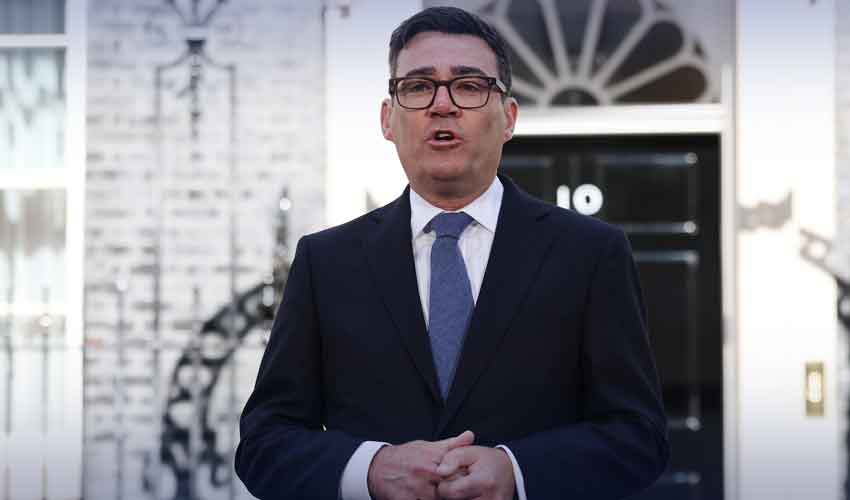
Andy Burnham officially became Britain's new prime minister on Monday, marking the country's seventh leadership change in a decade.
In his first address outside 10 Downing Street, Burnham pledged to end years of political instability and deliver a new economic model focused on improving living standards and restoring public trust.
Andy Burnham assumed office after accepting King Charles III's invitation to form a government at Buckingham Palace, the final constitutional step required to become Britain's prime minister.
Addressing supporters outside 10 Downing Street, the 56-year-old Labour leader acknowledged widespread frustration with politics and promised a fresh start.
Also Read: Starmer bows out, Burnham becomes UK prime minister
"I know people at home are fed up with politics. I hear you, and I want to be honest with you—we have not been good enough and we need to be better," Burnham said.
Dispensing with the traditional lectern and speaking without notes, he pledged to make the moment "a circuit-breaker for Britain," promising what he described as the biggest political and economic changes in four decades.
Burnham promises new political and economic model
Burnham said Britain needed to regain stability after years of political turmoil and frequent leadership changes.
"I have just come from Buckingham Palace, where I accepted His Majesty the King's invitation to form a government," he said. "I am acutely conscious that I am the seventh prime minister since 2016, making this a moment for reflection and new resolution."
He announced plans to introduce a new political model alongside a new economic model, arguing that previous governments had failed to provide the stability needed to improve living standards.
Later this year, Burnham said he would unveil a comprehensive 10-year Plan for Britain, outlining a long-term roadmap for the country's future regardless of political affiliation.
Cost-of-living relief
While the long-term strategy will be presented later this year, Burnham said immediate action would focus on easing financial pressure on households.
He pledged to announce measures from Tuesday to tackle the ongoing cost-of-living crisis and explain how those initiatives would be funded.
"Britain needs to show the world that we can regain our stability once again," Burnham said. "We have not been good enough, and we need to be better."
He promised to give Britons "some breathing space now" through targeted measures addressing rising living costs.
Homelessness named as first govt priority
Burnham announced that his first official instruction as prime minister would focus on ending rough sleeping across Britain.
"I will soon go through that door behind me and issue my first instruction to end rough sleeping in our country," he said, referring to the famous black door of Number 10 Downing Street.
He also pledged to build more public housing and council homes, arguing that expanding affordable housing would reduce welfare spending while helping Britain meet its fiscal rules and defence commitments.
The new prime minister also promised reforms to help more young people enter the workforce through education changes and expanded mental health support.
Cabinet appointments, finance minister under scrutiny
One of Burnham's immediate challenges will be naming his cabinet, particularly selecting a finance minister.
The appointment has generated intense speculation within the Labour Party, as previous governments have often been weakened by tensions between prime ministers and finance chiefs.
Energy Security and Net Zero Minister Ed Miliband had initially been viewed as a leading contender, although Interior Minister Shabana Mahmood is now considered the favourite for the role.
Burnham urged party members to ignore speculation, saying decisions on his team had not yet been finalized.
Policy changes already underway
Before formally taking office, Burnham moved to scrap plans requiring all employees to carry digital identity documents, a proposal originally designed to tackle illegal migration but criticised by a cross-party committee of lawmakers as a "fiasco."
His government is also expected to face major decisions on taxation, public spending, oil and gas policy, and the future of underperforming utility companies.
Burnham has indicated he wants stronger public oversight of essential utilities while using public procurement policies to help reindustrialise Britain.
Starmer exits after emotional farewell
Burnham took office shortly after outgoing Prime Minister Keir Starmer delivered his farewell speech outside Downing Street.
Calling the role "the privilege of my life," Starmer said his work as prime minister was complete.
"My work is done," he told supporters.
"I am confident that Britain is now stronger and fairer than it was two years ago."
Starmer wished Burnham success, saying: "He has my full support."
He concluded by saying he was leaving office "with a smile" and proud of what his government had achieved, receiving prolonged applause from ministers and aides gathered outside Number 10.
Unlike his predecessor, Burnham did not reference Starmer directly during his own address, choosing instead to focus on the reforms he intends to introduce.
Burnham's rise to the premiership follows his election as Labour leader, which he described last week as "the most significant change moment in our politics for 40 years."
Many Labour lawmakers believe Burnham is well placed to counter the growing popularity of Nigel Farage's Reform UK, a challenge they feared the increasingly unpopular Starmer could not overcome.
Burnham has promised to transform Britain's political system into one where life is more affordable and opportunities are shared more evenly across the country.
Britain enters another chapter of political change
Burnham becomes Britain's seventh prime minister in just ten years, reflecting a prolonged period of political instability following the 2016 Brexit referendum.
The country has faced repeated leadership changes alongside sluggish economic growth, a persistent cost-of-living crisis and mounting pressure on public services and utility companies.
Concluding his first speech as prime minister, Burnham appealed for national unity.
"I will put the care of people at the heart of everything I do," he said.
"I will give this my all, and I ask you all to pull with me. Let's build a new national sense of unity, of common purpose and positivity."
He ended with a message of optimism: "Let us make this the moment when Britain starts to believe again. The moment we bring back hope."


.jpg)