Iran has confirmed that diplomatic contacts with the United States are continuing through international mediators despite ongoing military confrontation, while insisting it will defend its national interests and hold Washington accountable for recent attacks.
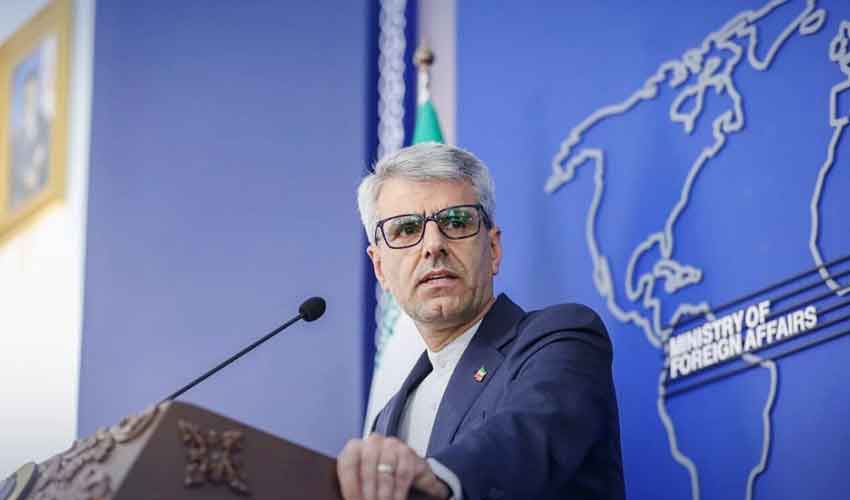
Speaking at a press conference, Iranian Foreign Ministry spokesperson Esmail Baghaei said mediators have presented new proposals aimed at reducing tensions, but stressed that Iran would continue responding to what it described as American aggression while keeping diplomatic channels open.
Baghaei said international mediators remain actively engaged in efforts to de-escalate the conflict between Tehran and Washington.
"We have been informed by mediators, we have received messages," he said, adding that several proposals have been conveyed to Iran. However, he declined to reveal their contents.
He also confirmed reports that mediators, including those involved in regional diplomacy, have put forward new ideas to revive negotiations.
According to Baghaei, "The principle of the matter is clear: mediators are working and trying to prevent tension from escalating."
Diplomacy, defense will continue together
The Iranian spokesperson rejected suggestions that Tehran must choose between negotiations and military action.
"I reject the duality of either war or diplomacy," Baghaei said, explaining that diplomacy and defense serve the same objective of protecting Iran's national interests.
He stressed that Iran's armed forces are responding firmly to what it calls US aggression while the country's diplomatic corps continues fulfilling its responsibilities.
Also Read: Iran in 'full-scale war' with US, says President Pezeshkian
"While our armed forces respond firmly and decisively to the source of American aggression, diplomacy is fully aware of its duties and spares no effort in fulfilling them," he said.
Baghaei added that Iranian diplomats would not abandon negotiations, just as the country's armed forces would not neglect their responsibility to defend Iran.
Iran accuses US of violating MoU
Baghaei strongly rejected claims that ambiguity in the Memorandum of Understanding (MoU) between Iran and the United States contributed to the current conflict.
He said the agreement is a brief document consisting of 14 clauses and argued that its language is completely clear.
"The text of the memorandum is brief, consisting of 14 clauses. Read the text. Which clause is ambiguous?" he said.
Also Read: Rubio says US ready for diplomacy if Iran serious
According to Baghaei, there is no justification for the United States violating either the text or the spirit of the agreement.
He also dismissed suggestions that Washington resumed attacks because of differences in interpreting the document.
'Commitment for commitment' Iran's position
Baghaei said Iran's approach toward the Memorandum of Understanding has always been based on reciprocal implementation.
"As long as the other side upheld its commitments, we adhered to ours. We have never been the first to violate an agreement," he said.
He added that after the United States repeatedly failed to fulfill its obligations, Iran announced it would suspend its own compliance.
Despite the breakdown, Baghaei said Iran had entered the agreement because it served the country's national interests and was not abandoning diplomacy altogether.
Strait of Hormuz remains central
Baghaei reaffirmed Iran's interpretation that Clause 5 of the Memorandum of Understanding places responsibility for managing the Strait of Hormuz with Tehran during the initial stage, in consultation with Oman.
He said Iran and Oman, as the coastal states bordering the strategic waterway, would continue consultations regarding its future.
"We must not allow this waterway to be exploited again as a threat against Iran's security and national interests," he said.
Baghaei added that Iran has remained in close coordination with Oman since the beginning of the ceasefire and is determined to exercise its sovereignty over the strait.
The Foreign Ministry spokesperson emphasized that Iran has no hostility toward neighboring countries. However, he urged regional governments not to allow their territory to be used for attacks against Iran.
He also claimed that the United States carried out a ground operation on Kharg Island and warned Washington that it would face consequences.
Iran condemns attacks on civilian infrastructure
Opening the briefing, Baghaei condemned attacks targeting medical centers, bridges, water facilities and other civilian infrastructure. He described such strikes as attacks on human dignity and people's right to life and security.
"An attack on civilian infrastructure, bridges, medical centers and essential services that people rely on daily is not merely an attack on geographic coordinates; it is an assault on the right to life, security and human dignity," he said.
Also Read: China backs Saudi Arabia's sovereignty following Houthi threats
Baghaei added that damage inflicted in one part of Iran affects the entire country.
"If Hormozgan is wounded, Mazandaran feels the pain; if Chabahar is targeted, the heart of Tehran skips a beat," he remarked.
Iran criticises attack on nuclear facility
Responding to questions about airstrikes on the Darkhovin nuclear facility, Baghaei said the site operates under International Atomic Energy Agency (IAEA) safeguards and is dedicated to energy production.
He argued that the attack undermines Washington's stated concerns over nuclear proliferation.
Baghaei also criticized what he called the IAEA's silence over the incident, saying it would further erode Iran's confidence in the agency.
Baghaei also responded to comments by US President Donald Trump suggesting that images from a school in Minab may have been generated using artificial intelligence.
He dismissed the allegation, insisting there was no doubt the United States deliberately carried out the attack.
Iran, he said, would continue documenting what it described as crimes committed in Minab, Lamerd and other locations and would seek accountability.
Judiciary denies reports of prisoner's release
Asked about President Trump's remarks regarding the reported release of an American citizen allegedly jailed in Iran on espionage charges, Baghaei referred the matter to the judiciary.
He said judicial authorities confirmed that no American prisoner matching Trump's description had been released and that the individual named had never been imprisoned or charged with espionage in Iran.
Separately, Ebrahim Azizi, chairman of the Iranian Parliament's National Security Committee, vowed that Iran's armed forces would avenge those killed in recent US attacks.
Also Read: Araghchi says US misjudged Iran’s strength
"The armed forces will not let the blood of innocent citizens go in vain," Azizi said.
He added that attacks on civilian infrastructure demonstrated that the United States had become frustrated in the conflict and described southern Iran as a longstanding stronghold of the country's defense.
Iran says negotiations remain possible
Despite the ongoing conflict, Baghaei reiterated that Iran is not withdrawing from negotiations with the United States.
He said diplomacy remains one of Tehran's principal tools for safeguarding national interests and that any future negotiations would proceed only with Iran's national interests as the guiding principle.
.jpg)