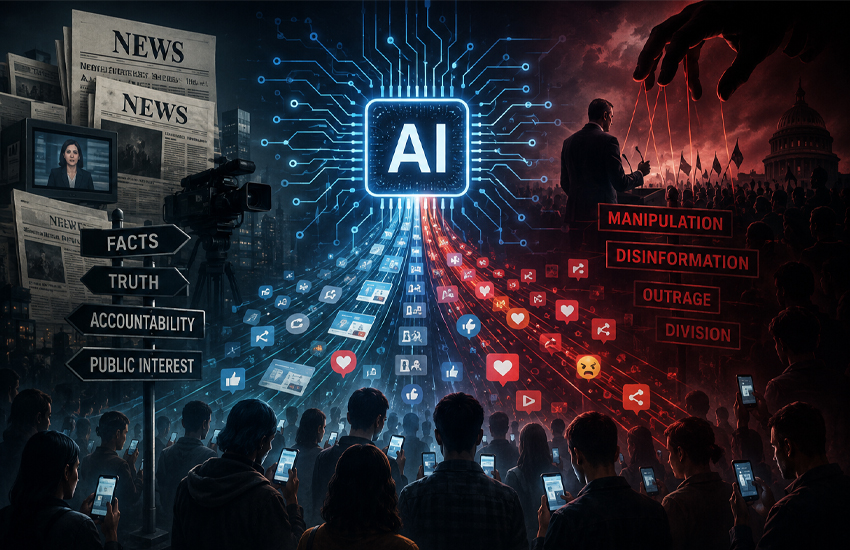
The media industry has spent the better part of two-and-a-half decades talking about technology. First, it was the internet, then social media, and now artificial intelligence. Yet, despite the rapid pace of change, the thing that remained consistent was society's reaction, with each breakthrough triggering both excitement and alarm, often in equal proportion.
Historically speaking, printing press took centuries to transform society, television reshaped politics over decades, and smartphones altered human behaviour in little more than 10 years. But no matter how different they were, each new technological development was treated as an intrusion. While some declared it the future, others called it the end of civilisation.
Today, by breaking well-established norms and crafting new ones, AI threatens to change everything once again. How fast this transformation will be completed, no one knows. Perhaps within a single generation, perhaps within a few years. And the worrisome thing is that neither governments, technology companies, nor news organisations are fully prepared for what the future holds.
Filtered Information
Ever since the advent of printing presses toward the end of the post-classical period, information has travelled through various institutions. Newspapers, broadcasters, universities, governments and publishers acted as filters between events and the public. They decided what mattered, what deserved attention and, in some cases, what remained hidden. However, technology brought about changes to the process of information dissemination. And, as expected, changes that tried to challenge the status quo were loathed. Print media did not accept the television wholeheartedly, which in turn did not welcome digital media, and now both are resisting AI integration.
The information-sharing arrangement that remained in place until a few years ago was not perfect per se, primarily because of the political and commercial interests that existed, coupled with various biases, but there was still a process, one that provided structure and accountability. Despite all shortcomings, information passed through layers of scrutiny before reaching millions of people. That process is rapidly disappearing.
Why News No Longer Seems New
Journalists everywhere are familiar with situations in which a political crisis erupts, a war begins, a natural disaster strikes, or a world leader makes a controversial statement. Before a reporter reaches the scene, millions of people have already seen videos, photographs, opinions, conspiracy theories, fact-checks, and misinformation circulating online. That removes the story from the category of “breaking news”, essentially because it is either stale or part of a global conversation.
This is the reality of the digital age. Information now travels faster than institutions can verify it, faster than governments can respond to it, and often faster than the truth itself.
Across the world, institutions that once controlled the flow of information are being dismantled and rebuilt in real time. What emerges from this transformation will define not only the future of journalism but also the future of democracy, governance, and public trust.
Editors to Algorithms: Architecture of Virality
For most of the twentieth century, information passed through human gatekeepers. The internet shattered that structure, and the old guard, despite their presence, simply lost control. Blogs allowed anyone to publish, social media gave everyone an audience, and smartphones transformed billions of citizens into potential reporters. The transition did not stop there. YouTube turned bedrooms into television studios and TikTok transformed ordinary users into global influencers. In such a situation, a new class of gatekeepers was needed, and that vacuum has been filled by algorithms.
Most people never see these algorithms, and only a handful understand how they work. Still, these mathematical formulas are the ones determining what billions of people read, watch and discuss every day. But make no mistake, algorithms have no interest in public service, and they certainly do not care about civic responsibility, journalistic ethics or informed citizenship, unlike editors. The only job they have is to keep users scrolling, clicking, sharing, and reacting, because everything else is secondary.
Resultantly, outrage often outperforms accuracy, while emotion spreads faster than evidence. This allows conspiracy theories to travel farther than corrections themselves. In short, a fabricated story can attract more attention in an hour than a carefully reported investigation receives in a week.
This phenomenon is not confined to just one country. It shapes elections in the United States, influences political discourse across Europe, fuels ethnic tensions in Asia and Africa, and increasingly affects democratic institutions worldwide.
Media and Politics: A New Power Struggle
The relationship between media and political power has never been simple. Historically, governments attempted to influence newspapers and broadcasters through regulation, ownership, advertising, or censorship. Today, political influence increasingly operates through digital ecosystems.
Political campaigns use sophisticated data analytics to target voters with personalised messages. Governments employ social media teams to craft narratives in real time, simultaneously leveraging influencers, online communities, and AI-generated content to influence public opinion. The result is a new information battlefield.
Information warfare, once associated primarily with military conflict, is now a routine feature of domestic politics. The consequences are profound. The internet was supposed to democratise information, which it did in many ways. However, the same technology that liberated information also made it harder to trust, especially when citizens cannot distinguish between verified reporting and manufactured content. And without trust, democratic debate becomes increasingly difficult.
Therefore, the challenge facing modern journalism is larger than just reporting the news; it is to preserve a shared foundation of reality.
The Social Media Revolution
No force has transformed media consumption more dramatically than social media. Today, people have access to more information than any generation in human history.
Platforms such as Facebook, Instagram, TikTok, YouTube, X, Snapchat, and WhatsApp have become primary sources of information for billions. For younger generations, particularly those under 30, traditional media is often no longer the first destination for news. This transformation has produced undeniable benefits.
Voices that could not make it to dailies or get airtime now have direct access to audiences, while independent journalists can build communities without relying on large media outlets. Moreover, social media has exposed corruption, documented human rights abuses, and amplified marginalised perspectives. But the same tools have also enabled misinformation at unprecedented scale.
False narratives spread globally within minutes. Deepfake videos can damage reputations before verification occurs, while coordinated disinformation campaigns can influence elections, social unrest, and public health responses.
Journalism’s Greatest Opportunity and Greatest Threat
Just as media organisations began adapting to the social media era, artificial intelligence arrived as the next transformative force.
Walk into any major newsroom today and ask a senior editor how many of the stories published last week were touched by artificial intelligence. Chances are that they will either not know or they will be uncomfortable telling you. Because the answer, increasingly, is “more than you think”.
AI systems can now write articles, summarise complex documents, generate images, create videos, translate languages, analyse data, and personalise content at extraordinary scale. Major news organisations around the globe are already using AI to automate financial reports, sports coverage, transcription, translation, and content recommendations.
The adoption has been slower in Pakistan, but the slow pace should not be mistaken for absence. After all, AI could dramatically improve newsroom productivity when used responsibly. On the other hand, synthetic content increasingly blurs the line between authentic reporting and fabricated information.
Journalism's Future and Journalists' Fate
It only makes sense that if machines can generate large volumes of content at negligible cost, publishers might be tempted to replace journalists rather than empower them. Yet journalism has never been merely the production of content. It is the exercise of judgment.
For budding journalists, the future is simultaneously full of possibility and deeply uncertain. Young journalists entering the profession now have access to tools their predecessors could not have even imagined.
The market is evolving rapidly, so students who invest in learning data journalism, multimedia storytelling, AI-assisted verification, and digital audience development will find themselves genuinely competitive. Of course, AI can process information at an unimaginable pace, but it cannot independently hold power accountable, cultivate sources, understand social context, or make ethical editorial decisions.
The most successful newsrooms of the future will not be those that resist AI. They will be those that integrate AI while preserving human oversight, transparency, and accountability.
Pakistan’s Digital Media Challenge
Pakistan stands at a particularly important crossroads in this transformation. With one of the world’s largest youth populations and rapidly expanding internet penetration, the country is witnessing an unprecedented shift toward digital media consumption.
Millions of Pakistanis now receive news primarily through smartphones rather than newspapers or television. Yet, while audiences have adapted quickly, many media institutions have not. Unfortunately, a large number of universities are still training students for a profession that no longer exists.
Print is contracting and television channels are laying off staff. Digital platforms have audiences but not yet the revenue models to employ the graduates. Adding to this difficult situation is AI eliminating the very entry points through which previous generations learned the craft.
Their survival depends on how quickly the institutions update the journalism curricula that were designed for the television and print era. Otherwise, this gap will evolve into a strategic national challenge. Investment that matters most right now is not in servers or software but in the people.
Training, digital literacy, AI education, and continuous professional development must become central priorities for media organisations, universities, and industry bodies.
The Business Model Crisis
Another issue that media outlets seldom like to talk about is the economic cost of keeping the business running. The advertising model that kept newsrooms alive for decades is simply gone. The money did not disappear; it moved to Google and Meta, who took the audiences that journalism built and monetised them without employing a single reporter.
Elsewhere, media organisations are scrambling for alternatives like subscriptions, memberships, newsletters, podcasts, and events. It is working out well for some, but most are struggling to reclaim what was once lost.
The math is even harder when it comes to Pakistan. Advertising rates are lower, digital payments remain limited, and audiences have grown so accustomed to free content that asking them to pay feels almost radical.
On the bright side, Pakistan is a country with a young, connected, opinionated population that is hungry for information that it can trust. Mobile-first consumption, growing digital connectivity, expanding fintech ecosystems, and increasing demand for trusted local information create potential pathways toward sustainable digital journalism.
What Comes Next
It would be wrong to believe that technology alone will determine the future of media. It will instead be shaped by choices. These include choices the governments make regarding regulations and freedom of expression, tech firms make regarding algorithmic accountability, and the ones media owners make about investment in journalism and innovation.
The list does not stop here. Educational institutions will also have to decide how they plan to train the next generation of reporters. Most importantly, it will revolve around the choices made by audiences about what information they want to consume, share, and support.
For a country like Pakistan, waiting is no longer an option. The country’s younger generation, hooked on their smartphones, is already forming its information habits today, deciding where it gets its news, who it trusts and what it believes. And whether we like it or not, these decisions are being shaped by algorithms that have no stake in this country's future.
Nevertheless, it must be kept in mind that every technological revolution rewired the relationship between information and power. Be it the printing press, television or the internet, each one created winners and losers, and the winners were rarely those who moved slowest. Artificial intelligence will be no different. Therefore, it would be unwise not to learn from the past mistakes of others.
The architects of this new information order are already at work. The main question is whether Pakistani journalism will have a seat at the table, or simply inherit whatever world those architects decide to build.
All that will depend, in the end, on choices. Technology has never been the soul of journalism. It has always been the journalist willing to ask the hard questions, follow the uncomfortable truth, and publish it regardless of consequence. Fortunately, that has not changed. Not yet.
One thing is clear that algorithms have already won the battle for information control. What remains undecided is whether journalism can still carve out a meaningful role in a world where attention has become the most valuable commodity and truth is often forced to compete with whatever keeps people scrolling.

.jpg)