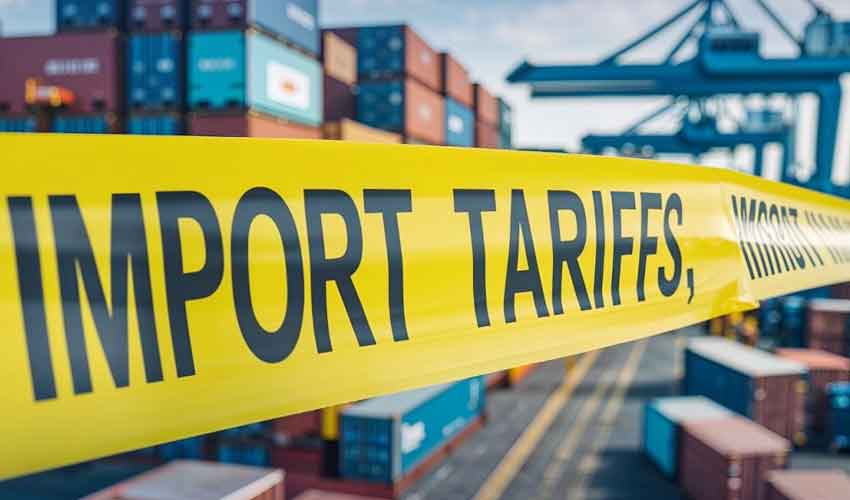
The Trump administration on Tuesday proposed new tariffs on imports from 60 economies, saying their failure to restrict goods made with forced labour was unfair to American workers and a burden on US commerce.
The US Trade Representative’s office said it had determined that additional duties should be imposed under a Section 301 unfair trade practices investigation.
According to the USTR, imports from Canada, Ecuador, the European Union, Indonesia, Mexico, Pakistan, Argentina, Bangladesh, Cambodia, El Salvador, Guatemala, Malaysia, Taiwan and Britain would face 10% additional duties linked to the forced labour investigation.
The agency said the remaining 45 countries investigated would face higher additional duties of 12.5%.
“The failure of our most important trading partners to address the importation of goods made with forced labour is unacceptable,” US Trade Representative Jamieson Greer said.
“This creates a dynamic where American workers are forced to compete globally on an unlevel playing field,” he added.
Move follows Supreme Court setback
The proposal is the latest Section 301 finding released as the Trump administration seeks to rebuild its emergency tariff program.
The move comes after the US Supreme Court struck down President Donald Trump’s tariffs under the International Emergency Economic Powers Act in February.
The announcement also comes ahead of the July 24 expiration of a temporary 10% tariff imposed by the administration on February 20.
The USTR said it was also proposing a textile mechanism that would allow a certain volume of apparel and textile imports to enter the United States at a reduced tariff rate.
However, the agency did not disclose the specific duty rates or import volumes under the proposed mechanism.
Several products exempted from tariffs
In its forced labour findings, the USTR said several products would be exempt from the proposed tariffs.
These include energy, rare earths and certain other metals, beef, coffee, certain fruits and vegetables, pharmaceuticals, organic chemicals and aircraft parts.
The USTR said it would accept public comments on the proposed tariffs and other remedies through July 6. A public hearing has been scheduled for July 7.
India faces 12.5% tariff proposal
The United States also proposed an additional 12.5% tariff on imports from India, placing it among 60 economies accused of failing to curb imports made with forced labour.
The move threatens to complicate ongoing trade talks between Washington and New Delhi. The proposal came on the second day of three days of talks between Indian trade officials and a US delegation led by Assistant USTR Brendan Lynch.
In a 92-page report released Tuesday, the USTR said India had “failed to impose and effectively enforce a forced labour import prohibition.”
The report described India’s policies as unreasonable and a burden on US commerce. India’s commerce ministry did not immediately respond to a request for comment.
Pakistan among countries facing 10% duties
Pakistan was listed among the economies that have forced labour import prohibitions but face a lower proposed duty of 10% for failing to enforce them effectively.
The same category includes Canada, Ecuador, the European Union, Indonesia and Mexico. India, meanwhile, was placed among 54 economies that lack a forced labour import prohibition and therefore face the higher proposed duty of 12.5%.
India may raise issue in trade talks
An Indian government source had told Reuters that New Delhi planned to raise the Section 301 investigation with Lynch’s team. The source said India would seek tariff relief as part of the broader bilateral trade deal being discussed with the United States.
Ajay Srivastava, founder of the Global Trade Research Initiative, said the USTR finding could be challenged.
He said the investigation was not about forced labour in Indian exports, but about whether India blocked imports linked to forced labour elsewhere.
“The proposed tariffs are viewed as part of broader US pressure tactics, and India should treat Section 301 actions and the India–US bilateral trade agreement negotiations separately,” he said.
Cotton supply chains under scrutiny
The USTR report also identified India as an intermediary in cotton supply chains linked to Chinese forced-labour inputs. The finding adds another layer of pressure on India as it negotiates with Washington over trade issues.
The forced labour tariff proposal follows another USTR action announced on Monday. The agency proposed a 25% duty on many Brazilian goods after a Section 301 investigation into Brazil’s digital trade practices and preferential tariffs.
The USTR is also expected to soon release findings from another major Section 301 investigation into excess industrial capacity in 16 trading partners, including China.

.jpg)