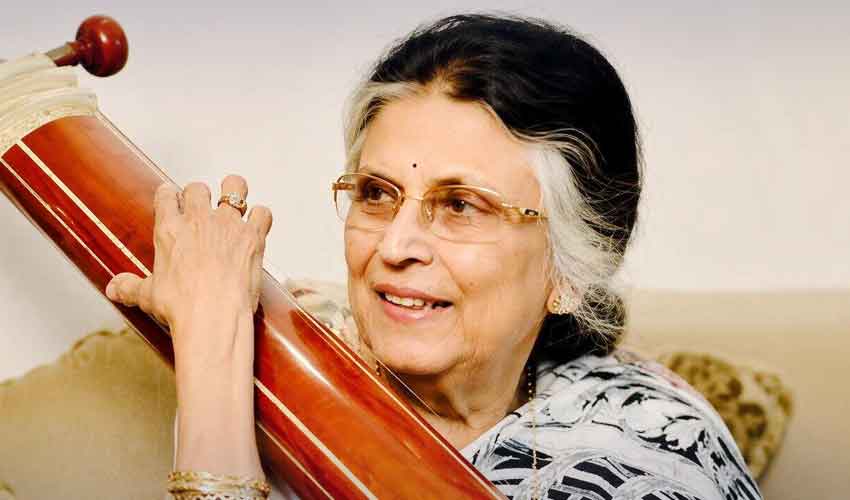
Legendary Indian playback singer Suman Kalyanpur, whose gentle and soulful voice shaped some of the most memorable songs of Hindi cinema’s golden era, passed away in Mumbai on May 31. She was 89.
According to author and close associate Mangala Khadilkar, Kalyanpur breathed her last around 8pm at her residence in Lokhandwala, Mumbai.
Khadilkar, who authored the acclaimed Marathi biography Suman Sugandh, said the veteran singer died due to age-related ailments. She said Kalyanpur spent her final days listening to her own songs, revisiting the music that made her a household name.
Kalyanpur had reportedly been unwell for a little over a month. Her last rites were scheduled to be held at 2pm on Monday at the Pawan Hans crematorium in Mumbai’s Santa Cruz. She is survived by her daughter, Charu.
Six-decade musical journey
Kalyanpur’s death marks the end of a remarkable career that lasted more than six decades. Known for her melodious vocals, classical finesse and clean tonal quality, she became one of the most respected playback singers of her generation.
Her voice was admired for its softness, restraint and emotional depth.
Kalyanpur’s unforgettable Hindi songs include Aajkal Tere Mere Pyar Ke Charche from Brahmachari, picturised on Shammi Kapoor and Mumtaz.
She also gave listeners evergreen numbers such as Na Na Karte Pyar Tumhin Se from Jab Jab Phool Khile, Tumne Pukara Aur Hum Chale Aaye from Rajkumar, Ajhun Na Aaye Baalma from Saanjh Aur Savera and Na Tum Humein Jaano from Baat Ek Raat Ki.
Other popular songs included Mere Sang Ga, Gunguna from Janwar and Chhodo Chhodo Mori Baiyaan from Miya Bibi Raazi.
Loved across languages and genres
Kalyanpur’s contribution extended far beyond Hindi cinema. She recorded songs in Marathi, Bengali, Kannada, Assamese, Odia and several other regional languages.
She was equally admired for devotional songs, ghazals and thumris, reflecting a rare versatility across forms of Indian music.
In Marathi music, Kalyanpur remained a deeply loved voice. Her evergreen Marathi songs include Ketakichya Bani Tithe, Sang Kadhi Kalnar Tula and Nimbonyachya Jhadamaghe.
These songs helped cement her place in the hearts of Marathi listeners across generations.
Suman Kalyanpur was born in Dhaka, now in Bangladesh, before her family eventually settled in Mumbai. She grew up as the eldest of five sisters in a conservative household where the girls sang because they could not play outside.
Her parents loved bhajans, and music became part of her life early on.
First steps into recording
As a teenager, Kalyanpur sang at a Ganpati Mahotsav after neighbours encouraged her. One neighbour, D.B. Jog, later invited her to sing for his Marathi film Shauchi Chandni in 1953.
Although the film never took off, it gave Kalyanpur her first experience inside a recording studio.
At 16, while studying at Sir J.J. School of Art, Kalyanpur was heard by noted singer Talat Mehmood at a college function. He praised her performance and connected her with the recording company HMV.
Though some at the company initially called her voice “amateurish,” she bagged a song in Darwaaza in 1954. Her debut came alongside Talat Mehmood in the delicate duet Ek Dil, Do Hain Talabgaar, and the film, produced by Ismat Chughtai, brought her early attention.
Career during Bollywood’s golden era
Kalyanpur rose to prominence in the 1960s and 1970s, when Mumbai’s music industry was producing songs at extraordinary speed and quality. This period later came to be remembered as the golden age of Hindi film music.
It was also an era dominated by the Mangeshkar sisters, Lata Mangeshkar and Asha Bhosle.
For much of her career, Kalyanpur lived with both the admiration and burden of being compared to Lata Mangeshkar. Her naturally delicate voice often led listeners to mistake her songs for Mangeshkar’s.
She was sometimes called “the other Lata,” especially when producers turned to her when Mangeshkar was unavailable, abroad, unaffordable, or not recording with Mohammed Rafi during royalty-related differences.
‘We were living in different times’
In a rare 2016 interview, Kalyanpur explained why the confusion grew. She said that in college she used to sing Lata Mangeshkar’s songs and that her own voice was “nazuk aur patli,” meaning fragile and thin.
She also said Radio Ceylon often played songs without announcing singers’ names, and records sometimes carried incorrect credits.
Kalyanpur added that singers like Shreya Ghoshal also had thin voices, but such confusion was less likely in modern times because the industry and media had changed.
Duets with Lata and recording history
Before her own songs became widely popular, Kalyanpur sang two duets with Lata Mangeshkar. One of them was Kabhi Aaj Kabhi Kal from the Balraj Sahni-starrer Chand in 1959, composed by Hemant Kumar.
Her song Na Tum Humein Jaano was recorded with her because S.D. Burman was reportedly not speaking to Lata Mangeshkar at the time.
Kalyanpur once recalled that after Independence, many people were excited to do something meaningful. Her father allowed her to sing but accompanied her to every recording because society was conservative and people were quick to talk.
After her marriage in 1958, her husband accompanied her to recording sessions.
Credit confusion around hit songs
When Na Na Karte Pyar was released by Kalyanji-Anandji, many listeners believed Lata Mangeshkar had sung it. In the late 1980s, Doordarshan’s popular show Chhaya Geet also credited the song to Lata Mangeshkar and Mohammed Rafi.
Kalyanpur’s daughter Charul later called Prasar Bharati to request a correction, but she said no one believed her because the song sounded like Lata Mangeshkar.
Later years in music
Kalyanpur’s last widely popular song in the film industry was Behna Ne Bhai Ki Kalai Pe from Resham Ki Dori in 1974. She sang around 100 songs for composer Usha Khanna and also worked with Anu Malik and Bappi Lahiri in the 1980s.
She gradually stepped away from the film industry in 1986 after singing for nearly 100 films.
Her final film song was recorded for Love 86, actor Govinda’s debut film, but it was never released. Composer duo Laxmikant-Pyarelal did not use her version and later rerecorded the song in Alka Yagnik’s voice.
In 1997, Kalyanpur recorded an HMV album featuring new versions of her old songs, but the album did not receive much attention.
Awards and recognition
Kalyanpur received several national and film awards during her long career. Her work across languages and genres earned her admiration from listeners, composers and fellow artists.
She remained one of the most graceful and enduring voices in Indian playback music.
Tributes pour in
Tributes poured in from music lovers and members of the film and music fraternity after news of her death emerged.
Maharashtra Chief Minister Devendra Fadnavis described her passing as the loss of a divine voice that enriched India’s musical heritage for generations.
NCP (SP) chief Sharad Pawar said her death marked the end of a golden chapter in Indian music. Deputy Chief Minister Eknath Shinde remembered her as an enduring symbol of Indian light classical and film music.
With Suman Kalyanpur’s passing, Indian music has lost one of its most gentle, graceful and memorable voices. Her timeless songs, however, continue to live on in the hearts of millions of listeners across generations.

.jpg)