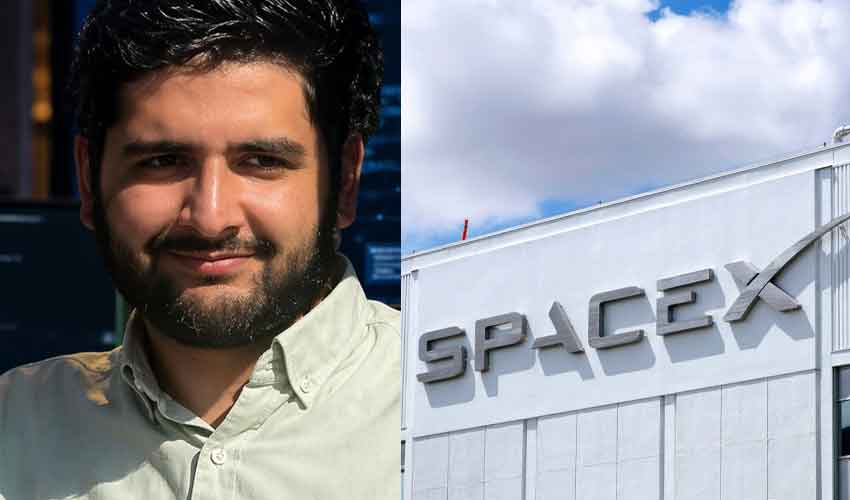
SpaceX has announced a major artificial intelligence partnership with Cursor, the AI code-generation startup co-founded by Karachi-born Sualeh Asif, with an option to acquire the company later this year for $60 billion.
The deal places Cursor at the centre of the rapidly growing AI coding market and highlights the rise of Asif, a Pakistani-born MIT graduate who is now counted among the world’s young AI billionaires.
SpaceX said in a post on X that it is working closely with Cursor to build what it described as the world’s best coding and knowledge-work AI.
Under the agreement, Cursor has given SpaceX the right to acquire the company later this year for $60 billion. If SpaceX does not proceed with the acquisition, it will pay $10 billion linked to the partnership.
SpaceXAI and @cursor_ai are now working closely together to create the world’s best coding and knowledge work AI.
— SpaceX (@SpaceX) April 21, 2026
The combination of Cursor’s leading product and distribution to expert software engineers with SpaceX’s million H100 equivalent Colossus training supercomputer will…
“The combination of Cursor’s leading product and distribution to expert software engineers with SpaceX’s million H100 equivalent Colossus training supercomputer will allow us to build the world’s most useful models,” SpaceX said.
The company said the partnership would combine Cursor’s software and product expertise with SpaceX’s large-scale AI infrastructure, including its “Colossus” training supercomputer.
What Cursor does
Cursor, founded in 2022 and based in San Francisco, develops AI tools that help software developers generate, edit and manage code. The company focuses on artificial intelligence for software engineering and knowledge-based tasks, especially for business users.
Cursor competes in a fast-growing market where AI companies are racing to become the preferred platform for developers. Its rivals include Microsoft’s GitHub, OpenAI’s Codex and Anthropic’s Claude Code.
OpenAI said on Tuesday that Codex had reached four million weekly users, up from three million only weeks earlier. Anthropic has also reported strong revenue growth from Claude Code.
According to Reuters, Cursor is among several Silicon Valley startups, alongside OpenAI and Anthropic, that have attracted large numbers of developers by using AI to automate coding.
Sualeh Asif’s journey from Karachi to MIT
Sualeh Asif, originally from Karachi, attended Nixor College before enrolling at the Massachusetts Institute of Technology. He represented Pakistan at the International Math Olympiad from 2016 to 2018. While at MIT, he also started an AI-powered search engine company.
Asif later co-founded Anysphere, the maker of Cursor, with three friends from MIT.
According to Forbes, Cursor now has more than $1 billion in annualised revenue, making it one of the fastest-growing AI startups. Forbes has also estimated Asif’s net worth at around $1.3 billion.
Cursor reached a valuation of $29.3 billion in November 2025 after raising $2.3 billion in a funding round co-led by Accel and Coatue.
Forbes reported that millions of software developers at around 50,000 enterprises, including Nvidia, Adobe, Uber and Shopify, use Cursor to generate and edit code.
The development is expected to strengthen xAI, the maker of the Grok chatbot, in the AI coding market. Musk announced in February that SpaceX would acquire xAI as part of his broader plan to expand artificial intelligence infrastructure and develop future AI models.
According to The Guardian, the Cursor partnership could help xAI gain a stronger foothold in AI coding, a segment where it has lagged behind competitors.
The deal also gives Cursor access to significantly more computing capacity to train and improve its models.
Colossus, the supercomputer cluster linked to xAI in Memphis, has been described by the company as one of the largest AI training systems in the world. SpaceX said its computing setup is equivalent to one million Nvidia H100 chips.
SpaceX expands AI ambitions
SpaceX’s move into AI comes as the company prepares for a possible public listing. The rocket and satellite company has set the pace in the global space launch market through reusable rockets that reduce the cost of sending satellites into orbit. It also operates Starlink, the world’s largest satellite constellation.
Musk has said SpaceX’s absorption of xAI is “not just the next chapter, but the next book” for the companies. He has also linked the push into AI with a long-term vision of solar-powered, satellite-based data centres that could run future artificial intelligence models.
“Global electricity demand for AI simply cannot be met with terrestrial solutions,” Musk wrote when discussing the merger of his companies.
He argued that the only logical solution was to move resource-intensive AI operations to locations with vast power and space.
The project fits into Musk’s broader ambition to build colonies on the Moon and Mars. He has described it as a first step towards becoming a “Kardashev II-level civilization,” a futurist term coined in the 1960s by a Soviet astronomer for a civilization capable of using all the energy of its home star system.
SpaceX IPO could be historic
The announcement comes as SpaceX prepares for a highly anticipated stock market listing.
SpaceX filed confidential papers earlier this year with US regulators, setting the stage for what could become the largest public stock offering in history.
According to reports, the company could list its shares on a public exchange by July, with The Wall Street Journal reporting that the IPO could come as early as June.
Media reports suggest SpaceX could raise around $75 billion through the offering and reach a valuation of nearly $1.75 trillion. If successful, SpaceX would become one of the world’s ten largest companies by market capitalization.
OpenAI and Anthropic are also reportedly planning public listings this year.
The partnership follows earlier links between Cursor and Musk’s companies. Two product engineering heads at Cursor, Andrew Milich and Jason Ginsberg, said in March that they had joined SpaceX to contribute to the company’s lunar projects and xAI.
Musk welcomed them at the time, saying: “Orbital space centres and mass drivers on the Moon will be incredible.”
Pakistani tech sector reacts to Sualeh Asif’s rise
The announcement has triggered strong reactions within Pakistan’s technology sector, where many see Asif’s success as proof of the country’s talent pool.
Bilal bin Saqib, chairperson of the Pakistan Virtual Assets Regulatory Authority, described the deal as a proud moment for Pakistan.
“This is a profoundly proud moment for Pakistan, and undeniable proof for our youth that there is no ceiling to what they can achieve,” he said in a post on X.
Saqib said Asif’s journey shows that Pakistan does not lack talent, but lacks the ecosystem to support it locally. He said Asif’s time at MIT gave him access to capital, computing power and a supportive environment, which many young Pakistanis do not find at home.
“We don’t lack brilliant minds; we lack the right conditions,” Saqib said, adding that with the right policy, capital and leadership, Pakistan could produce more such success stories.
Former federal IT minister Umar Saif also praised Asif, calling him the kind of role model Pakistani youth need. He said young Pakistanis should look up to self-made innovators rather than “property dealers, tax evaders, bank defaulters, rent seekers” or those born into wealth.
Saif described Asif as “a self-made kid from a middle-class family in Karachi” who studied at MIT, built a major technology company and changed the way people write code.
He noted that Asif is now worth more than $1 billion at the age of 26.
AI coding market heats up
The SpaceX-Cursor deal reflects the growing commercial importance of AI coding tools. Developer-focused AI has become one of the earliest areas where artificial intelligence companies have found strong business traction.
Cursor’s rapid growth, its enterprise customer base and its possible $60 billion sale to SpaceX show how valuable AI code-generation tools have become in the global technology race.
For Pakistan, the rise of Sualeh Asif has added a powerful local dimension to that story, turning the Karachi-born founder into a symbol of what young Pakistani talent can achieve on the global stage.

.jpg)