A team of scientists at the University of Konstanz has made a groundbreaking discovery that challenges a law considered accurate for over 300 years.
They have identified a completely new type of sliding friction that behaves differently from traditional expectations.
Unlike conventional friction, which increases proportionally with the weight of an object, this newly observed friction arises without direct physical contact between two surfaces. Instead, it is caused by the collective behavior of magnetic elements within the system.
For centuries, Amontons’ law held that friction is directly proportional to the normal force pressing two surfaces together. Everyday examples, such as the difficulty of moving a heavy object versus a light one, seemed to confirm this. The law explained friction as the result of microscopic contact points between surfaces increasing under pressure, creating resistance to motion.
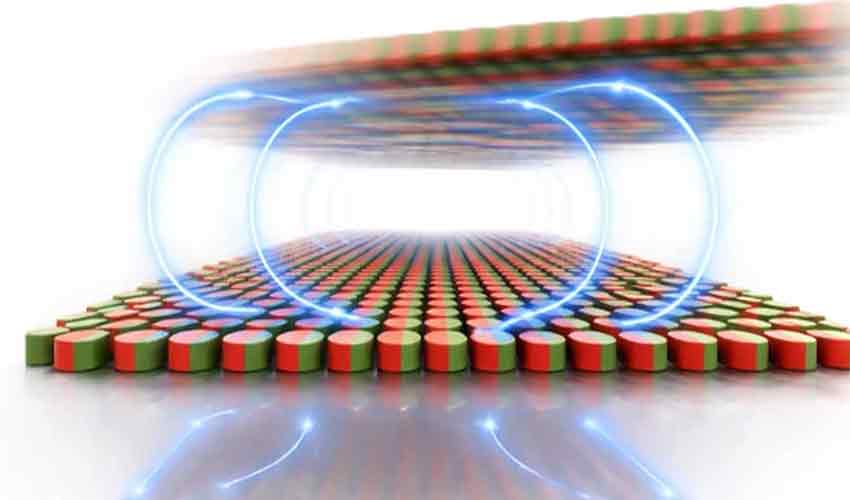
The Konstanz team designed a tabletop experiment using freely rotating magnetic elements arranged in two-dimensional layers. Remarkably, the two layers never actually touched each other, yet their magnetic interaction produced a measurable frictional force.
Even more surprisingly, the friction did not always increase with weight. Instead, it peaked when the internal magnetic order of the layers became disrupted, showing that friction can emerge from internal magnetic arrangements rather than physical compression.
By adjusting the distance between the layers, researchers were able to control the effective load and directly observe changes in the magnetic structure during motion, providing a new understanding of how friction can arise in systems beyond classical laws.
This discovery could redefine the fundamental principles of friction and open up possibilities for advanced materials and mechanical systems that rely on magnetic interactions rather than physical contact.



.jpg)