“If you know the enemy and know yourself, you need not fear the result of a hundred battles. If you know yourself but not the enemy, for every victory gained you will also suffer a defeat. If you know neither the enemy nor yourself, you will succumb in every battle.”
This famous quote by Chinese General Sun Tzu (544 BC-496 BC) carries the very essence of strategic intelligence and the importance of espionage in achieving victory and avoiding defeat. Throughout his work, the late military strategist repeatedly laid emphasis on the importance of espionage and deception during warfare. “There is no place where espionage is not used,” he said.
Espionage in the 20th and early 21st centuries always had everything, including tools like spy satellites that never slept, phone metadata banks stretching into petabytes, hacked CCTV feeds from every corner of the globe, and of course, agents and their informants. The only thing it lacked was the one thing that mattered the most, which is, the ability to make sense of it all. That is why intelligence agencies, despite having collected mountains of information, could never process it fast enough to be decisive. That is, until now.
A recent Financial Times report lays bare the truth behind the airstrikes that led to Iranian Supreme Leader Ayatollah Ali Khamenei’s assassination. According to the publication, Mossad agents, CIA operatives, and their allies had long hacked into Tehran's sprawling network of traffic cameras and CCTV systems, feeding terabytes of footage into secure servers for years. Patterns of movement, security convoys, and the Supreme Leader's erratic schedule were captured in exhaustive detail.
In the shadows of traditional intelligence work, speed was the enemy. Human bandwidth simply could not keep pace with the volume, turning potential game-changing insights into yesterday's news. But the world saw that change forever in the lead-up to February 28 US-Israeli attacks on Iran.
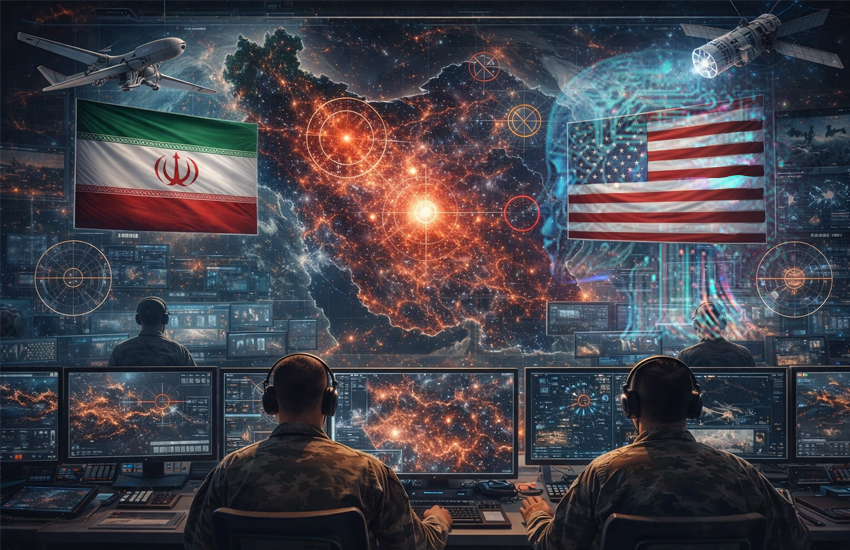
The intelligence network that was built over years by Mossad's cyber teams and bolstered by CIA-shared feeds apparently shifted from passive collection to active, AI-driven orchestration. Hacked cameras that used to just record started feeding live streams into advanced AI-integrated systems that mapped "patterns of life" for Khamenei and his inner circle. Algorithms sifted through the deluge and flagged anomalies that no human team could catch in time. In short, instead of just monitoring, the systems started building scenarios on an unprecedented scale.
Reports suggest that thousands of potential strike windows were simulated, risks weighed, and contingencies modelled. The finalization of the attack crystallized when intelligence pinpointed a rare daytime gathering of Iran's top leadership at Khamenei's compound. What would have taken weeks of manual analysis was distilled into hours, which enabled US-backed Israeli jets to execute with devastating precision.
Both the US and Israel have claimed victory, and are marvelling at their military gear. But one thing no one is talking about is that none of this could have been possible without artificial intelligence.
And at the heart of it all was Claude, Anthropic's powerful model, which the US military deployed in the critical hours to strike 1,000 targets within 24 hours despite recent political friction.
Reports have confirmed that Claude was embedded in the Central Command (CENTCOM) operations, handling intelligence assessments, target identification, and battle-scenario simulations that "shortened the kill chain" from days to minutes. It was Claude that fused the hacked CCTV feeds with satellite intel and human resources to predict Khamenei's movements with accuracy, stress-testing strike options, and recommending the daylight window that caught Iran's defences off-guard.
Without Claude, the raw data from those compromised cameras would have remained unmanageable and overwhelmed planners, lost to the limitations of human processing. There is no doubt that the precision that vaporised the compound simply would not have materialized otherwise.
No matter how scary or disturbing, but this is the new reality of warfare. Conflicts are no longer just managed with AI; they are apparently being resolved by it. In today's world, where a single leader's location can shift the balance of power across the Middle East, frontier models like Claude have become the ultimate force multiplier.
It turns extensive information into actionable clarity, democratizes strategic foresight, and allows smaller teams to achieve what entire intelligence agencies once struggled to deliver. The strike on Khamenei stands as a stark testament to the fact that traditional espionage laid the groundwork, but AI delivered the kill shot.
For years, counties and organizations have been debating the ethical and strategic implications of these tools, which is understandable. But at the same time, one truth is undeniable… THE AGE OF HUMAN-ONLY INTELLIGENCE IS OVER!
It is high time we realised that in future wars, superiority will not go to the side with the bigger army but to the side that knows not just its enemy but also what’s coming next.
Also, Pakistan and emerging economies must urgently embrace sovereign, on-premises AI to safeguard national security because foreign-hosted LLMs and cloud services turn sensitive government and citizen data into exploitable intelligence, as seen in Iran.
Authorities must wake up to the fact that digital and cognitive sovereignty is non-negotiable, and any delayed investment in this regard risks strategic subordination in the AI age. This is exactly what happened on February 28, and those with strategic vision see it not just as the day on which Iran’s supreme leader but also as the day artificial intelligence went to war.

.jpg)