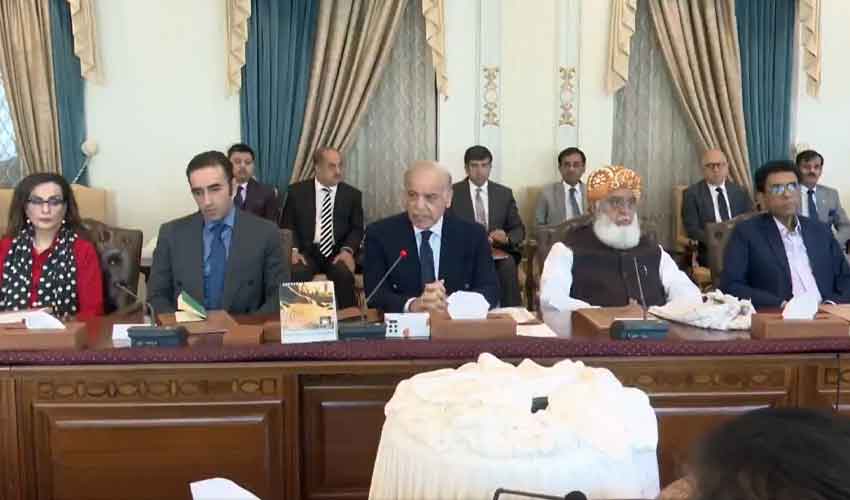
Prime Minister Shehbaz Sharif chaired a key meeting of parliamentary leaders and political party representatives to discuss the evolving regional situation, including the Iran–Israel conflict and security on Pakistan’s western border.
Senior officials briefed participants on Pakistan’s diplomatic efforts, security operations, and regional engagements.
A meeting of leaders and representatives of parliamentary parties, chaired by Prime Minister Shehbaz Sharif, was held to brief political leadership on the current security and regional situation.
The briefing focused on developments in Afghanistan, Iran, and the broader Middle East, as well as Pakistan’s diplomatic and security responses.
Participants were informed about Pakistan’s policy stance and strategic priorities amid rising regional tensions.
Pakistan’s diplomatic efforts
During the session, Foreign Office officials briefed political leaders on Pakistan’s foreign policy and diplomatic initiatives following the Iran–Israel conflict, according to sources.
Officials told participants that Pakistan has made every possible effort to reduce the intensity of the conflict and prevent further escalation in the region.
The briefing also noted that Pakistan immediately condemned the martyrdom of Ayatollah Ali Khamenei and the attacks on Iran, reaffirming its stance on regional stability.
Participants were informed about Pakistan’s diplomatic engagement after Iran’s attacks on Gulf and Arab countries, as Islamabad seeks to de-escalate tensions.
Pakistan’s top priority
Officials emphasized that reducing tensions between Iran and the Gulf countries remains Pakistan’s top diplomatic priority.
Prime Minister Shehbaz Sharif also took the participants into confidence regarding his contacts with Middle Eastern leadership, sharing details of diplomatic discussions aimed at easing tensions in the region.
Deputy Prime Minister and Foreign Minister Ishaq Dar also briefed the participants on the diplomatic front, particularly Pakistan’s bilateral contacts with Gulf and Arab countries.
Security briefing on western border operations
In addition to regional diplomacy, the meeting included a security briefing on Pakistan’s western border situation and the growing tension in the region. Participants were informed about the ongoing operation against the Afghan Taliban regime, with security officials presenting updates on the campaign.
Officials also briefed political leaders on the success of Operation Ghazab Lil Haq, outlining the objectives achieved in Afghanistan. The security leadership provided detailed information about Pakistan’s strategic goals and operational progress along the western frontier.
Leaders and representatives of various political parties attending the meeting expressed complete satisfaction and confidence in the government's decisions.
Opposition divided over attending briefing
The opposition remained divided over participation in the government’s in-camera briefing on regional and global issues, including Afghanistan, Iran, and the Middle East.
Jamiat Ulema-e-Islam (JUI-F) chief Maulana Fazlur Rehman accepted the government’s invitation to attend the briefing.
However, Pakistan Tehreek-e-Insaf (PTI) declined to participate, with the party’s political committee stating it would not attend the session due to the absence of a meeting with PTI’s founder. No member of the PTI ended up attended the meeting.
A delegation led by Maulana Fazlur Rehman, accompanied by Maulana Atta-ur-Rehman and Senator Kamran Murtaza, attended the in-camera briefing at the Prime Minister’s House. According to sources, Maulana Fazlur Rehman consulted opposition parties three times before agreeing to participate.
Earlier, he met Barrister Gohar inside Parliament House and advised him to attend the briefing.
Attempts to convince opp leaders
Maulana Fazlur Rehman also contacted Mahmood Achakzai and Barrister Gohar later in the day, urging them to attend the meeting. He suggested that opposition members should first attend the briefing and then collectively demand an in-camera briefing for the entire parliament.
However, sources said Achakzai and Gohar appeared constrained by the PTI political committee’s decision not to attend. There is also uncertainty regarding the participation of the Pakhtunkhwa Milli Awami Party and Majlis-e-Wahdat Muslimeen, with the possibility that both parties may skip the session.
Govt urges opposition to participate
Prime Minister’s Adviser Rana Sanaullah had earlier urged opposition parties to attend the briefing, listen to the Prime Minister, and share their views on the national security situation.
Meanwhile, Opposition Leader Mahmood Achakzai argued that instead of selective briefings, the government should call a joint session of parliament and provide a comprehensive security briefing to all members.




.gif)
.jpg)