Pakistan is accelerating its transition towards clean energy, with the government aiming to increase the country's green energy share to 90% by 2035 through large-scale battery storage, local manufacturing and greater reliance on renewable power.
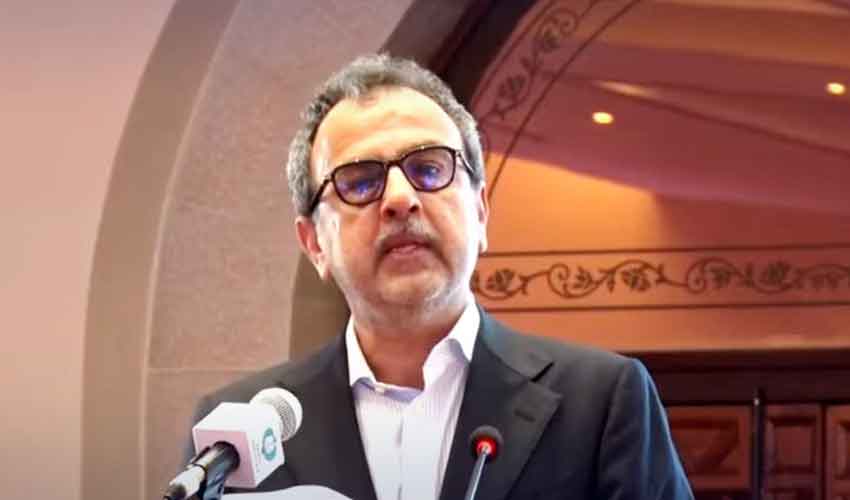
Speaking at the Solar Storage Conference in Islamabad, Federal Minister for Energy Awais Leghari said Pakistan's energy sector is undergoing a historic transformation, where the challenge is no longer electricity generation but its efficient storage and use.
Leghari said approximately 55% of Pakistan's electricity system now comes from green energy sources, including hydropower, nuclear, wind and solar energy.
He added that solar power adoption is expanding rapidly across the country, with independent estimates putting Pakistan's installed solar capacity at 38 gigawatts (GW).
According to the minister, every unit of electricity generated from local resources strengthens Pakistan's energy independence.
"Every unit of electricity generated from local sources is a unit that no external conflict, no sea route and no currency crisis can take away from us," he said.
He described solar and wind power as Pakistan's sovereign energy assets, saying battery storage would make them available whenever consumers need electricity rather than only when the sun is shining.
Battery storage policy enters final stage
The federal minister announced that the government's Battery Energy Storage System (BESS) policy is now in its final stages.
He said a National Steering Committee on Battery Energy Storage Systems has already been established, while technical and regulatory working groups have also been formed to develop the framework.
According to Leghari, discussions have already approved pilot battery storage projects, which will help shape the country's future energy infrastructure.
Grid stability now biggest challenge
Leghari acknowledged that the rapid growth of solar energy has also created grid stability challenges. He said Pakistan currently experiences surplus electricity generation during daytime hours, while electricity demand rises significantly during the evening.
As a result, battery storage systems have become essential for maintaining stable electricity transmission and balancing supply with demand.
"The challenge today is not electricity production but its efficient use and storage," he said.
April LNG disruption highlighted need for storage
The energy minister cited the disruption in RLNG supplies from Qatar in April as a practical example of why Pakistan needs battery storage.
He said the interruption in LNG imports forced authorities to implement night-time load shedding, although widespread solar power helped meet electricity demand during daylight hours.
According to Leghari, this experience convinced the government to accelerate work on a national battery storage policy.
Dependence on imported fuel remains concern
The minister warned that Pakistan's electricity sector still depends heavily on imported fuels, making the country vulnerable to international crises.
He noted that the recent regional conflict and the closure of the Strait of Hormuz pushed global oil prices higher, creating fresh challenges for countries relying on imported energy.
Leghari stressed that reducing dependence on imported fuel is critical for Pakistan's economy as well as its long-term energy security.
Local battery manufacturing
Rather than importing batteries, the government wants to develop a domestic battery manufacturing industry, Leghari said. He revealed that the Ministry of Industries is finalising a policy to promote local battery production.
The government also plans to encourage local engineering, system integration and battery management software development, creating new industrial opportunities alongside the clean energy transition.
Leghari said the government wants consumers to store surplus electricity generated during the day and use it during evening hours when demand is higher.
He added that the government is proposing a mechanism under which consumers could receive Rs6 per unit for surplus electricity stored during the day.
According to the minister, a similar model is already operating in Australia.
However, he acknowledged that the International Monetary Fund (IMF) has not yet agreed to the proposal.
"There is no obstacle in implementing this system, but the IMF has not accepted it so far. We will continue efforts to convince the IMF," he said.
Clean energy target depends on battery storage
Leghari said Pakistan cannot achieve its goal of 90% clean energy by 2035 without investing in battery energy storage systems.
He reiterated that strengthening renewable energy, expanding battery storage and increasing reliance on locally generated electricity will improve energy security while reducing exposure to global fuel price shocks.