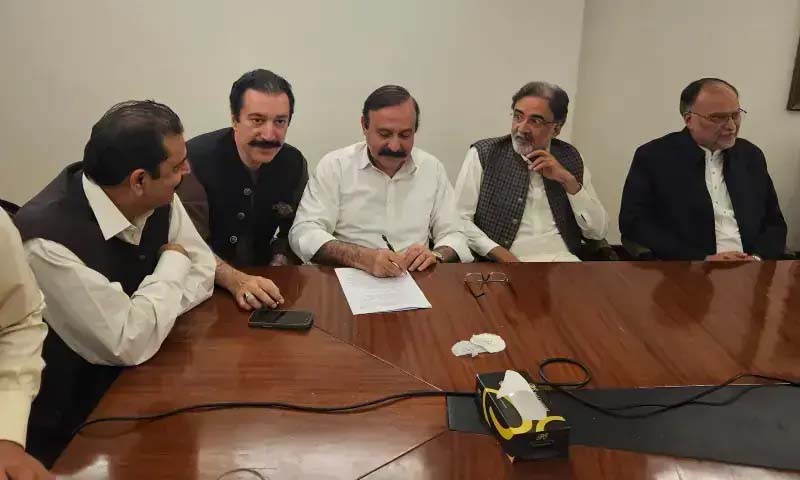
The decision by the Joint Awami Action Committee (JAAC) to proceed with its protest despite extensive engagement by a high-level political delegation has raised questions about its commitment to the dialogue process.
The delegation established to address the issue included Federal Minister for Planning Ahsan Iqbal, Federal Minister Tariq Fazal Chaudhry, Prime Minister’s Adviser Rana Sanaullah, Qamar Zaman Kaira, Raja Pervez Ashraf, Shah Ghulam Qadir, Tariq Farooq, the Prime Minister of Azad Jammu and Kashmir (AJK), and Chaudhry Yasin. The group represented broad political consensus and a concerted effort to address outstanding concerns.
According to sources, 35 of JAAC’s 38 demands have already been accepted. In these circumstances, characterising the negotiations as a failure is regarded as inconsistent with the facts, as the majority of public welfare-related demands have already been addressed.
The remaining three demands differ in nature and relate to fiscal policy, constitutional arrangements and political consensus. Reports indicate that such matters cannot be settled through street pressure, ultimatums or fixed deadlines.
Official figures show that AJK generates approximately Rs60 billion in annual revenue, while its total budget exceeds Rs300 billion. To bridge the gap, the government provides around Rs240 billion to Rs250 billion each year, highlighting the importance of fiscal considerations in decisions relating to taxation and revenue.
The demand for the abolition of Advance Tax is also being viewed in light of these financial realities, as any reduction in revenue could affect resources available for public services, development schemes and welfare programmes.
Pakistan’s support to AJK extends beyond budgetary assistance. More than 63,000 refugees displaced since 1989 receive direct stipends, with annual expenditure estimated at around Rs15 billion.
The issue of privileges and benefits available to the elite also remained open for discussion. The federal delegation indicated its willingness to examine reforms and reasonable reductions in such benefits, while stressing the need for practical proposals and structured negotiations.
The matter of the 12 refugee seats has been described as a constitutional issue that cannot be resolved through pressure tactics. The seats represent refugees from Indian-occupied Jammu and Kashmir, and any amendment would require broad political consensus and constitutional procedures.
It was argued that comparisons with Indian-occupied Jammu and Kashmir do not reflect the constitutional realities, as refugee representation in AJK exists because of a recognised refugee population whose political representation remains a constitutional responsibility.
Officials maintained that expenditure by AJK on refugees residing in Pakistan remains limited when compared with the extensive financial, development and welfare assistance provided annually by the Government of Pakistan.
Political observers say the central question is no longer whether grievances were heard, as most demands have already been accepted. The focus has instead shifted to whether the objective is the resolution of issues or the continuation of a protest movement despite substantial concessions.
An appeal has been made to the public to support dialogue rather than confrontation, with the view that continued escalation during ongoing negotiations serves political interests more than public welfare.
Citizens have also been urged to seek transparency from all parties and assess positions on the basis of facts rather than slogans. Observers maintain that every demand should be examined in light of its financial, constitutional and administrative implications.
Experts have argued that constitutional matters can only be resolved through democratic institutions, legislative processes and political consensus, rather than through pressure from street protests.
The public has also been urged to reject any course of action that creates unnecessary instability, disrupts daily life, harms economic activity or generates law and order concerns for ordinary citizens.


.jpg)