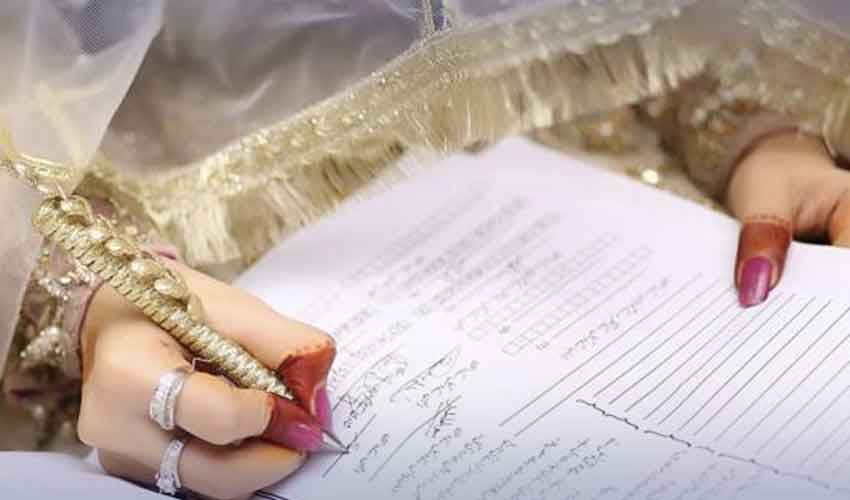
The Lahore High Court (LHC) has ruled that an agreement made at the time of marriage, in addition to the marriage certificate, is legally valid and binding on the husband.
Justice Sajid Mahmood Sethi issued an 11-page written decision on the petition of Muhammad Khan, upholding the subordinate court’s ruling and ordering the petitioner to give his wife a five-marla house as promised in a separate agreement.
The court said the husband is bound to fulfill not only the dower (haq mehar) mentioned in the marriage certificate but also other promises made to the wife at the time of marriage.
The court ruled that items or commitments mentioned in a separate marriage agreement are also enforceable.
It declared the trial court’s decision to give the five-marla house to the woman correct and dismissed the husband’s request to set aside that ruling.
According to the written judegment, the woman had filed a claim for recovery of haq mehar, a five-marla house and iddah expenses. The woman maintained that her husband had promised to give her a five-marla house through a separate agreement made on the day of marriage.
The husband, however, argued before the court that the agreement was fake and had been prepared later.
Witnesses proved agreement in court
The court noted that, according to the record, both witnesses to the agreement appeared before the court and proved the document through their statements. The judgement said the burden of proof lies on the person alleging that a document is forged.
In this case, the husband was required to provide evidence to support his claim that the agreement was fake.
The LHC observed that the husband had opposed the forensic examination of signatures and thumb impressions on the agreement. The court ruled that refusal to allow forensic examination weakened the husband’s position.
“A truthful person is not afraid of scientific examination,” the judgement stated.
Haq Mehar is wife’s legal right, not husband’s favour
The court made clear that dower is the legal right of the wife and not a matter of the husband’s will, favour or generosity. The judgement said that, in the eyes of law, dower is considered a debt owed by the husband to the wife.
It also ruled that the mere mention of Rs5,000 as dower in the marriage certificate does not make a separate agreement ineffective.
The court said a woman’s failure to demand dower during marriage cannot be treated as a waiver of her legal right. The judgement noted that women often avoid demanding dower during marriage because of social and domestic pressure.
The court said family matters must be decided not only on technical grounds but also in light of social realities.
Haq Mehar can be agreed verbally, in writing or later
The court further observed that haq mehar may be agreed upon verbally, in writing or even later. The judgement said Muslim law allows a husband to increase haq mehar even after marriage.
The court added that the purpose of family courts is to resolve family disputes with justice and balance. After reviewing the record, witness statements and legal principles, the Lahore High Court upheld the subordinate court’s decision.
The court dismissed Muhammad Khan’s petition and maintained the order requiring him to give the woman a five-marla house as promised in the separate marriage agreement.
.jpg)
.jpg)