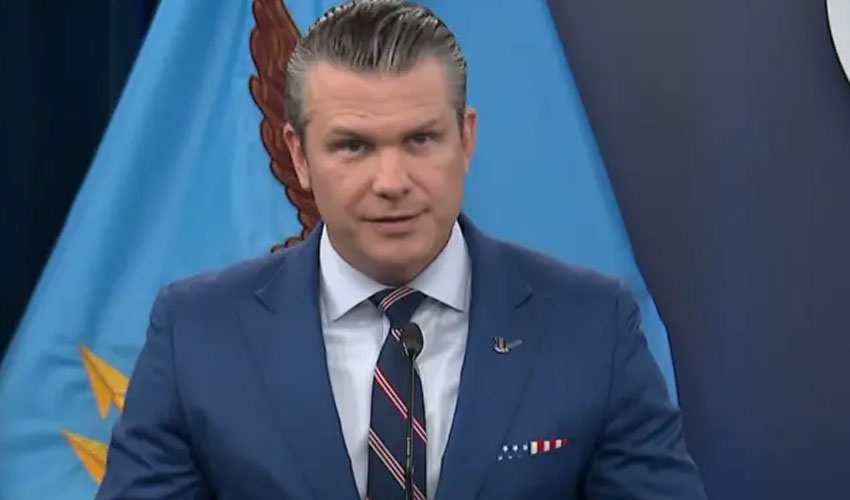
US Defence Secretary Pete Hegseth has warned that Washington is ready to restart attacks on Iran if diplomacy fails, while urging Asian allies to sharply increase defence spending to counter China’s growing military power.
Speaking at the Shangri-La Dialogue in Singapore on Saturday, Hegseth said the United States remained capable of resuming operations against Iran, even as it continued to focus on security challenges in the Asia-Pacific region.
US says it is ready to resume strikes on Iran
Hegseth said negotiators from Washington and Tehran were still trying to bridge major differences blocking a deal, but made clear that the US military was prepared if talks collapsed.
“Our ability to recommence if necessary... we are more than capable,” Hegseth said.
He added that US stockpiles were strong enough to support operations in the Middle East and elsewhere.
“Our stockpiles are more than suited for that, both there and around the globe, so we’re in a very good place,” he said.
Trump seeking a strong Iran deal
The Pentagon chief said President Donald Trump remained “patient” and wanted to secure a “great deal” that would ensure Iran does not obtain a nuclear weapon.
Hegseth said any agreement with Tehran would have to be a good deal for the United States.
Also Read: Trump says will soon decide on Iran deal, demands reopening of Hormuz
His remarks came a day after Trump said he would meet advisers in a secure White House room to make a “final determination” on a proposal to end the Iran war. The plan would extend an early-April truce for another 60 days, giving negotiators more time to work toward a permanent end to the conflict.
Iran war has raised global economic pressure
The war, launched by the United States and Israel on February 28, has killed thousands of people, mainly in Iran and Lebanon.
It has also caused global economic pain by pushing up energy prices, particularly after Iran’s effective closure of the Strait of Hormuz, a key route for global oil shipments.
Hegseth pushed back against concerns that the Middle East conflict could distract Washington from Asia-Pacific priorities.
“We can do two things at one time,” he said.
US says Asia-Pacific remains a priority
Addressing defence leaders, military officials and diplomats at the Shangri-La Dialogue, Hegseth said the United States had not turned its back on the Asia-Pacific region despite being engaged in conflict with Iran.
He said Washington was “super-charging” its defence industrial base to rapidly increase weapons production.
“We’re building 2X, 3X, 4X the munitions very soon to ensure that all of our operations plans are properly funded throughout the world,” Hegseth said.
Hegseth urges allies to counter China
The US defence secretary urged Asian allies to ramp up military spending to counter China’s growing power and prevent Beijing from dominating the region.
“There is rightful alarm regarding China’s historic military buildup and the expansion of its military activities in the region and beyond,” he said.
Also Read: Iranian sources term Trump remarks on deal as ‘mixture of truth, lies’
Hegseth warned that a Pacific dominated by any hegemon would damage the regional balance of power.
“No state, including China, can impose its hegemony and hold the security or prosperity of our nation and our allies in question,” he said.
Allies asked to spend 3.5% of GDP on defence
Hegseth said the United States expects its Asian allies and partners to increase defence spending to 3.5% of GDP.
He said Washington itself had pledged a $1.5 trillion investment in its military this year.
According to Hegseth, US allies want stability, not escalation, and Washington is offering disciplined strength and steady resolve.
“What they want, and what the United States delivers, is strength that is disciplined, resolve that is steady, and leadership that is confident enough to speak and walk softly while carrying a big stick,” he said.
US-China ties better, but concerns remain
Despite his warnings over China’s military expansion, Hegseth struck a measured tone on relations between Washington and Beijing.
He said US-China ties were “better than they have been in many years,” pointing to more frequent military-to-military engagement as a way to manage tensions.
“We are meeting more frequently with our Chinese counterparts by maintaining open lines of military-to-military communication,” he said.
‘No freeloading,’ Hegseth tells allies
Hegseth echoed President Trump’s long-standing demand that US allies take on a greater share of their own defence costs.
“The era of the United States subsidizing the defence of wealthy nations is over,” Hegseth said.
“We need partners, not protectorates,” he added. “We don’t have a strong alliance unless everyone has skin in the game. No freeloading.”
Also Read: Naval blockade on Strait of Hormuz shipping to be lifted: Trump
He said there would be a clear change in how Washington deals with uncooperative allies.
“The days of you taking advantage of the American people’s tax money are over,” Hegseth said.
Praise for regional allies and expectations from Japan
Hegseth praised contributions from South Korea, the Philippines, Australia, Singapore, Malaysia and Thailand.
He also said Japan was taking concrete steps to strengthen its defence posture, but stressed that Washington had high expectations from Tokyo.
Tokyo and Washington “must each pull our weight to strengthen the US-Japan alliance,” Hegseth said.
Taiwan arms decision rests with Trump
Asked about arms sales to Taiwan, Hegseth downplayed concerns that a multi-billion-dollar package could be affected by US weapons stockpile pressures amid the Middle East conflict.
“We feel very good about our stockpiles and how we use them,” he said.
Taiwan, which China views as its own territory, has been waiting for the US to approve an arms package that could be worth up to $14 billion.
Trump created uncertainty in Taipei after saying, following a meeting with Chinese President Xi Jinping this month, that he was undecided on whether to approve the package.
Hegseth said any decision on future arms sales to Taiwan would rest with President Trump, while signalling there had been no change in Washington’s longstanding approach.
“Those decisions will depend on the president and the nature of that relationship,” Hegseth said. “There’s been no change in our status.”
.jpg)