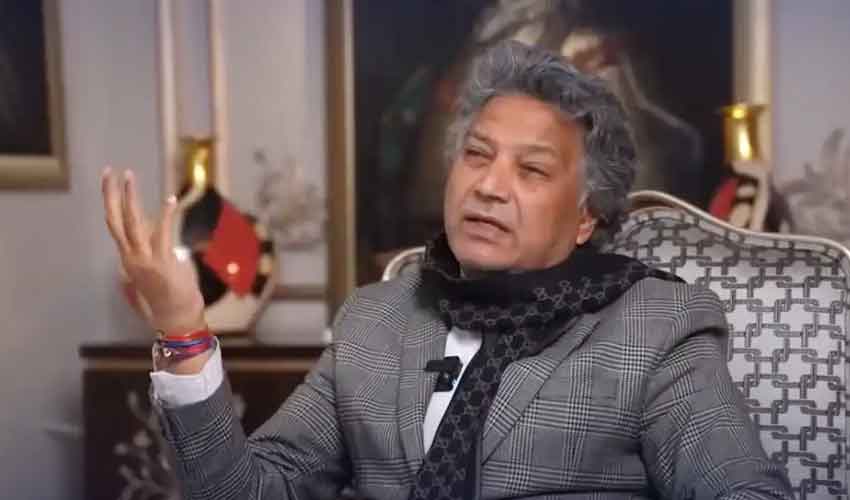
Mehmood Bhatti, once known for his rise in France’s ready-to-wear fashion industry, has admitted to tax fraud and aggravated money laundering before the Paris Court of Appeals.
The case has sharply changed the public image of a man long promoted as a Pakistani immigrant success story, philanthropist and fashion entrepreneur.
Bhatti built his reputation around his arrival in France in the mid-1970s at the age of 20.
In his 1999 autobiography and several interviews, he described himself as a self-made entrepreneur who climbed the social ladder through hard work, business skill and persistence.
His best-known product, a black faux-leather jacket, reportedly sold several million units. His story also inspired the character played by Richard Anconina in the 1997 French film La Vérité si je mens (Would I Lie to You?), directed by Thomas Gilou.
Links to celebrities and political circles
During his rise, Bhatti became connected with jet-set and political circles in France.
In August 1984, actor Anthony Delon and businessman Alexandre Djouhri were seriously injured in a car crash near the Belgian border while travelling in Bhatti’s Mercedes.
Djouhri is currently on trial alongside former French president Nicolas Sarkozy in the alleged Libyan campaign funding case.
Guilty plea in tax fraud case
On May 19, Bhatti appeared briefly before the Paris Court of Appeals and pleaded guilty to tax fraud committed between 2009 and 2012. He also admitted to aggravated money laundering linked to the period between 2009 and 2014.
According to Le Monde, the investigation found that Bhatti benefited from a loan system routed through a company based in the United Arab Emirates. Investigators said the financial flows were used to fund an extravagant lifestyle.
Reduced sentence after appeal
Bhatti had earlier been convicted in November 2024, but appealed the verdict. After admitting to the charges, he received a reduced sentence: a two-year suspended prison term, a €150,000 fine, and a 10-year ban on managing a company.
Authorities also ordered the confiscation of luxury assets, including high-end watches and Jaguar vehicles.
This is not Bhatti’s first encounter with the French legal system. In 2001, he was charged with financial fraud and was suspected of involvement in a money-laundering network uncovered during an investigation.
Reputation under renewed scrutiny
For years, Bhatti was celebrated in Pakistan as a symbol of overseas success and philanthropy. He moved among political leaders, celebrities and business circles, while receiving public recognition and state-level honours.
But the latest conviction has raised questions about how much of his public image was built on self-promotion and carefully managed reputation rather than independently verified business achievements.
The façade began to unravel after an investigative documentary and later reporting by Le Monde. It brought renewed attention to Bhatti’s finances, business dealings and past legal disputes.
What was once presented as an immigrant success story is now being reassessed as a carefully constructed persona shaped by glamour, influence and financial deception.



.jpg)